 14 DAY TRIAL //
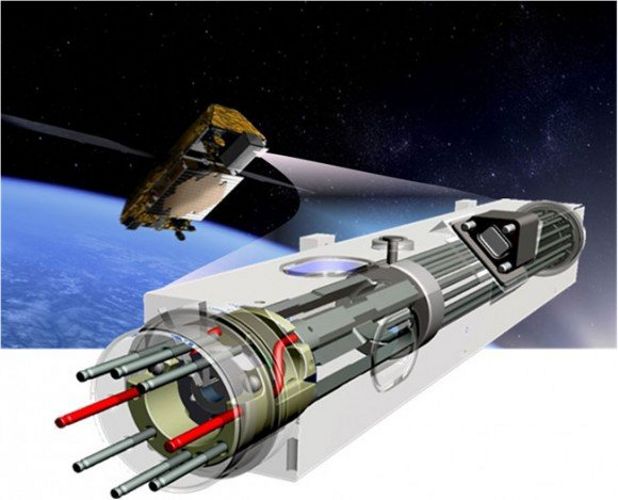
 Officials at NASA announced recently that the agency is working on a new generation of atomic clock, devices used for keeping exquisitely-precise track of time. At this point, spacecraft for instance rely on GPS satellites, which do have some degree of error.
The goal of the American space agency is to develop a technology that would be about 10 times more accurate than anything in existence today. The Deep Space Atomic Clock (DSAC) team at the NASA Jet Propulsion Laboratory (JPL), in Pasadena, California, is responsible for building the instrument.
According to the group, the small, low-mass atomic clock will be based on mercury-ion trap technology. The group has to design, build, launch and test the new instrument in real-life conditions as soon as possible, Universe Today reports.
Accurate time-keeping is necessary on the vast majority of spacecraft, especially planetary probes and space telescopes. Instruments aboard these vehicles need to be kept accurately in tune with the universal time, in order to avoid pointing errors.
The DSAC experts believe that the new technology will provide great benefits in terms of security enhancements to new missions. It could also potentially provide significant cost benefits, and minimize the risk of navigation and pointing errors.
The technology demonstrator will be funded by the Space Communications and Navigation (SCaN) Office, in the Human Exploration and Operations Mission Directorate at NASA Headquarters, and the NASA Office of the Chief Technologist.
Early estimates indicate that network operation costs could be reduced by as much as $11 million per years. At the same time, the amount of usable science and navigation data could increase by as much as 100 percent.
Additionally, the navigation and radio science data quantity received could increase by a factor of 2 to 3, by allowing coherent tracking to extend over the full view period of Earth stations. At the same time, navigation data accuracy could increase by 1,000 percent, the team says.
As a practical example, a new version of the existing Mars Reconnaissance Orbiter (MRO) that would rely on the new technology could rid itself of the need to communicate with the NASA Deep Space Network in order to acquire the correct time.