 14 DAY TRIAL //
 One of the basic things any kid knows about planets is that they spin around a star. What goes without saying is that a planet in fact spins around a single star. Apparently, this is not the case with a recently discovered celestial body, which has an orbit so elongated and tilted, that astronomers believe it's being pulled, or at least was in the past, by two stars, instead of the average one, ScienceNow reports.
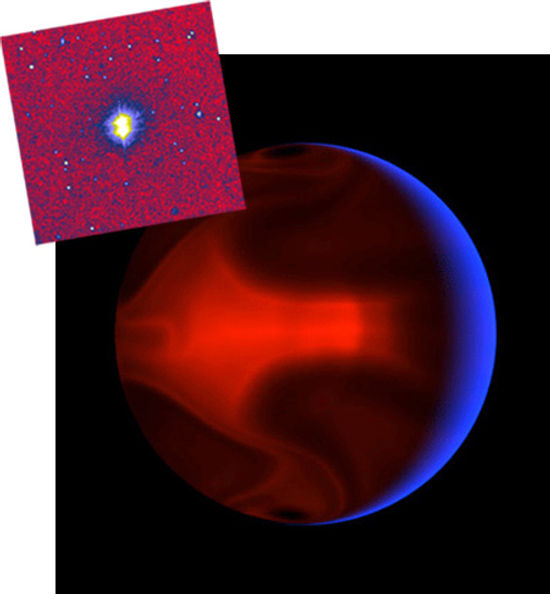
The exoplanet HD 80606b is located a measly 190 light-years away from Earth, and is about four times more massive than Jupiter, which, naturally, makes it a gas giant. It was first discovered back in 2001, and, at the time, astronomers attempted to explain its peculiar tilt and axis of rotation as being the result of influences received from its parent star's partner, another star some two billion kilometers away. Together, the two were suns for a binary system, which means that the two components spin around each other. This means that HD 80606b is the first planet in such a system ever to be discovered.
However, in spite of their best efforts, astronomers lacked the means to establish for sure if the peculiarities the gas giant exhibited were owed to gravitational interactions from its star's companion, or if there were some other factors at work. A recent investigation effort, led by experts from eight observatories, from Massachusetts to Hawaii, has concentrated on tracking the motions of the planet as it moved in front of its star for 11 hours. Each of the telescopes could only contribute a part of the data, because, naturally, the Earth moved as well.
However, it was possible to observe the planet continuously for many hours, something that was not done before for HD 80606b. The team's report, published in the latest issue of The Astrophysical Journal, shows that the planet is, indeed, the first in a new class of alien worlds. It is at the same time subjected to the gravitational pull from both members of the binary star system, University of Florida in Gainesville expert and study co-author Eric Ford says.
Jack Lissauer, a planetary scientist at the NASA Ames Research Center, in Moffett Field, California, adds that there is a small chance the planet was set on its current orbit by a collision with, or close approach to, another massive planet in its vicinity. However, he argues, that seems highly improbable, given the presence of the companion star nearby.