 14 DAY TRIAL //
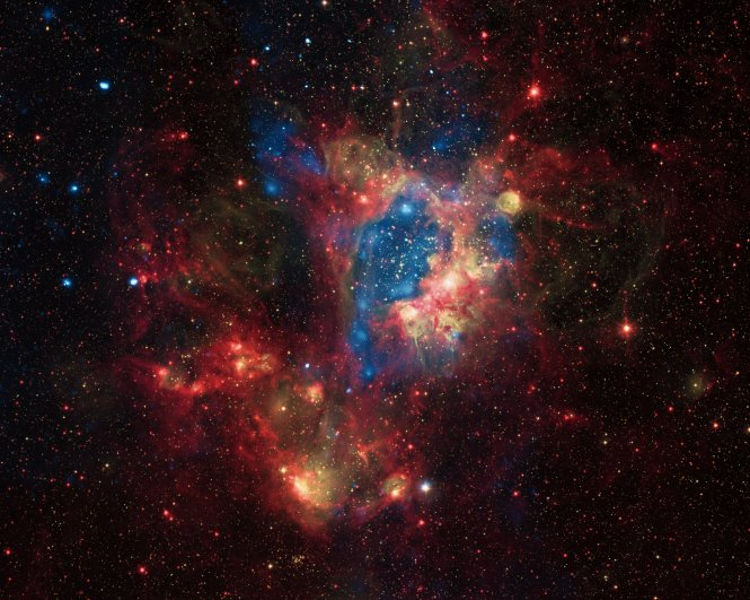
 A large superbubble located near the Milky Way was recently observed by three telescopes, at X-ray, optical and infrared wavelengths. The object, a large stellar cluster, is known as NGC 1929.
The structure lies within the Large Magellanic Cloud (LMC), a dwarf galaxy orbiting the Milky Way. Astronomer say that the cluster is about 160,000 light-years away from Earth, and that it is a lot brighter than they expected to observe.
The image to the left is a composite view of NGC 1929, featuring X-ray data from the NASA Chandra X-ray Observatory (blue), infrared data from the NASA Spitzer Space Telescope (red), and optical data from the 2.2-meter Max Planck / ESO telescope, in Chile (yellow).
Scientists reveal that the cluster is embedded in N44, a star-forming nebula that produces new cosmic fireballs at a past pace. NGC 1929 itself produces young stars, some of which are very massive.
As a result, the entire cosmic structure is enveloped in large volumes of energetic radiations. Newly-born stars tend to have very strong winds, which are even stronger if the star has a lot of mass. These objects also produce copious amounts of ultraviolet light, ionizing the gas around them.
Massive stars are also in the habit of expelling matter from their surfaces at very high speed. They tend to have relatively short life spans, of just a few million years. By comparison, the Sun will live for a total of 10 billion years as a yellow dwarf, and for another 3 billion years or so as a white dwarf.
Superbubbles such as NGC 1929 occur when some of these massive stars blow up in huge supernova explosions. The shock waves carve out immense cavities all around the former star. However, some of these bubbles tend to produce more X-rays that theories predict.
According to previous studies conducted with Chandra, there are three main sources of such radiations.
The first source is the winds released by massive stars, as well as by supernova remnants. X-rays are also produced when supernova shock waves strike the boundaries of the cavities. The third source is the hot material that continuously evaporates from the cavity walls.
“Only with long observations making full use of the capabilities of Chandra has it now become possible to distinguish between different sources of the X-rays produced by superbubbles,” NASA scientists say in a statement.
Chandra is managed by the NASA Marshall Space Flight Center (MSFC) in Huntsville, Alabama, for the space agency's Science Mission Directorate, at NASA Headquarters, in Washington DC.