 14 DAY TRIAL //
 A group of engineers at the NASA Goddard Space Flight Center (GSFC), in Greenbelt, Maryland, announces the development of an extremely black material. They say that their creation is capable of absorbing more than 99 percent of photons that hit it.
This ability extends from far-infrared to ultraviolet wavelengths, and includes visible light. The material only emits an infinitely small amount of light. To the human eye, it appears to be blacker than the blackest black, GSFC experts explain.
They believe that the new technology could be successfully used for a variety of space applications that were not possible until now. The fact that it can operate in multiple wavelengths is definitely a plus.
Details of how it operates were presented at a recent SPIE Optics and Photonics conference. A number of 10 GSFC technology experts created the material. Their efforts were led by expert John Hagopian.
“The reflectance tests showed that our team had extended by 50 times the range of the material’s absorption capabilities,” the team leader explains, saying that the secret to how the material functions is the special coating that covers it.
“Though other researchers are reporting near-perfect absorption levels mainly in the ultraviolet and visible, our material is darn near perfect across multiple wavelength bands, from the ultraviolet to the far infrared. No one else has achieved this milestone yet,” Hagopian explains.
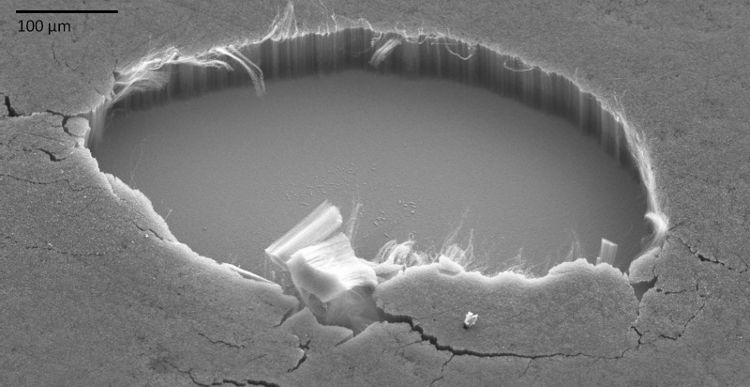
He adds that the surface of the material is covered in a very thin layer of multi-walled carbon nanotubes (MWCNT), each of which is about 10,000 times thinner than the width of a human hair. Their arrangement is what does not allow photons to bounce off.
“We were a little surprised by the results. We knew it was absorbent. We just didn't think it would be this absorbent from the ultraviolet to the far infrared,” adds SPIE paper coauthor and GSFC engineer Manuel Quijada, who was responsible for carrying out the reflectance tests.
Experts with the research group say that the new material may be used for example to create heat coatings for near-infrared sensors aboard dedicated space telescopes. The stuff would remove most of the heat the instruments create, and then radiate it into deep space.
Overall, the material is capable of absorbing 98 percent of photons in long and far-infrared bands, as well as 99,5 percent of visible-light and ultraviolet wavelengths. The team now plans to continue improving its MWCNT-based technology.