 14 DAY TRIAL //
 Up until quite recently, holograms seemed to be something one could really encounter solely in science fiction movies or novels, but the developments of modern technology have taken this concept a lot closer to reality. And one of the latest such innovations comes from Japan (where else?), in the form of a color holographic system actually capable of displaying 3D images of moving subjects in normal lighting conditions.
As Masao Oonishi from Nikkei Electronics (TechOn!) informs us, researchers from the National Institute of Information and Communications Technology (NICT) have developed this color electronic holography based on integral photography, which shoots subjects in normal lighting conditions by using a video camera with a fly-eye lens composed of a number of microlenses. The same fly-eye lens is used to display 3D images.
The hologram itself is displayed on separate LCD panels, each of them for one of the RGB (red, green and blue) colors. Then, the holographic images on the panels are reproduced with laser beams and synthesized by a very powerful computing system so that a color 3D video can be displayed in real time, and, most importantly, in just about any type of room, regardless of the kind of lighting fixtures installed there.
This technology is quite different from what we've seen in this field so far, and that's because "traditional" holograms were created by separately shooting the subject with red, blue and green laser beams. In this way, it was practically impossible to render moving images, let alone those of objects in normal lighting conditions.
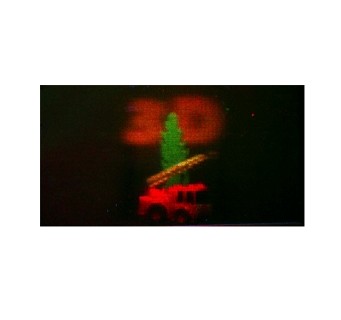
Unfortunately, although this technology is indeed groundbreaking, the visible results are still...well, not exactly breathtaking. Thus, for now, the image has a height of solely 1cm, but NICT is planning on taking things further and creating 4-cm images in a few years' time.
We are just a few, but there are many of you, Softpedia users, out there. That's why we thought it would be a good idea to create an email address for you to help us a little in finding gadgets we missed. Interesting links are bound to be posted with recognition going mainly to those who submit. The address is  .
.