
Search Perform an advanced search query SOFTPEDIA
 
SOFTPEDIA
Updated one minute ago
HomeSubmit a program for being reviewedAdvertise on our websiteGet help on surfing our websitesSend us your feedbackGet information about our XML/RSS backend and how to use itBrowse the news archiveVisit our discussion forumVizitati forumul in limba romana


KLIP
  1. HOME
  2. SCIENCE
  3. TECHNOLOGY
  4. WEBMASTER
  5. SECURITY
  6. MICROSOFT
  7. LINUX
  8. APPLE
  9. GAMES
  10. TELECOMS
  11. REVIEWS
  12. LIFE & STYLE
  13. EDITORIALS
  14. INTERVIEWS
  15. RSS
Welcome!
Hello, Guest

Login if you have a Softpedia.com account.

Otherwise, register for one.

SPACE

More Weird Objects Raining from the Heavens

- Australian finds rocket debris on his property

By: Gabriel Gache, Science News Editor

No surprise here! Out of the few couple of millions of objects floating around in Earth's orbit, at least some must come back from time to time. Just last week, a cattle farmer from Australia reported another incident in which a strange object suddenly appeared in a remote region of the northern outback.
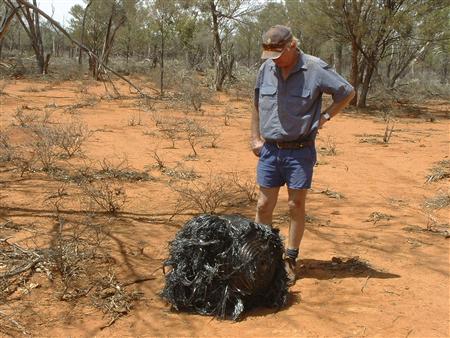
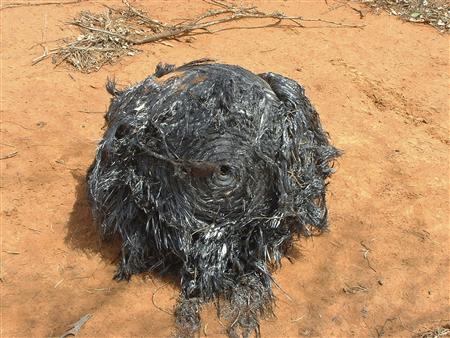
He believes that the giant ball of twisted metal, which appeared for no reason, might be a piece of space junk from a rocket that launched a communications satellite.

James Stirton, the farmer that discovered the strange metallic object, lives in the northern Queensland about 800 kilometers away from Brisbane and owns 40,000 hectare of land in the west region of the state. Although he found the odd-shaped ball during last year, Stirton only started investigating its whereabouts last week.

"I was riding out to check some cattle, and I came around the corner and there it was in a paddock. I know a lot about sheep and cattle but I don't know much about satellites. But I would say it is a fuel cell of some stage of a rocket," said Stirton in a interview last week. He contacted the US aerospace companies in the hope that he would find out what the object really was.

According to Stirton, the metallic object seems to be hollow inside and it is covered by a layer of carbon-fiber material. During the late 1970s, the US space station Skylab was disabled and sent towards Eath's atmosphere to be destroyed. However, the space laboratory didn't burn entirely during the re-entry and some parts reached the Earth's surface intact. To be more precisely, they fell in a western region of Australia.

The Australian authorities politely sent a ticket to NASA for littering, while the United State President Jimmy Carter in person called a motel near the crash location to apologize for the inconvenience.


MORE RELATED ARTICLES: Spread Your Ashes on The Moon for $10,000 Watch Out, It's Raining Rocket Parts Lynx Mark I, the Future of Commercial Spaceflight NASA's Newest Concept Vehicle How to Clean Up Space Israeli Citizens Want Anti-Missile Shield Rocket Fails Upon Satellite Orbit Insertion
 
Comments | Link here | Subscribe
Print | Send to friend
Today's News | Yesterday's News

Search:


28th March 2008, 10:45 GMT | Copyright (c) 2008 Softpedia | Contact:
Read by 511 user(s) | Rating: | 2 vote(s) so far | Cast your vote:
More Weird Objects Raining from the Heavens - USER OPINIONS


We are sorry, there are no opinions available for this article.


SHARE YOUR OPINION ABOUT More Weird Objects Raining from the Heavens

Since you are not logged on, your comments will have to be approved before being displayed.
Click here to login, or register.
Your Name:
Your Email:
Type in the result:
Your Opinion:


DO YOU WANT TO CONTACT US?  

If you have some comments or you want to send us some information you can send us an email directly to .
You can use the form below for the same purpose.
Your full name: (at least 3 characters)
Your email address: (at least 5 characters)
Message subject: (at least 5 characters)
Message text:
(at least 10 characters)
Type in the result:


© 2001 - 2008 Softpedia. All rights reserved.
Softpedia™ and Softpedia™ logo are registered trademarks of SoftNews NET SRL.
Copyright Information | Privacy Policy | Terms of Use | Contact Softpedia | Update your software | Archive