 14 DAY TRIAL //
 Researchers have shown monkeys can count to four and are aware of differences between languages like Dutch and Japanese. Now, Harvard psychologists find that monkeys have such a complex understanding of causal mechanisms that they can draw correct conclusions about novel situations.
"Our studies reveal a striking continuity between humans and monkeys in their capacity to draw causal inferences without the help of familiarity with the events or situation," says Marc Hauser, a Harvard professor of psychology. "This ability highlights the richness of the monkey mind in terms of its understanding of the material world."
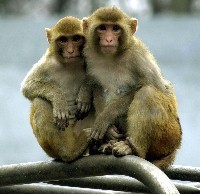
Hauser has been working with a colony of free-ranging rhesus monkeys on an island off Puerto Rico for many years. He and Bailey Spaulding, formerly a student of his, tested individual adult males and females of the colony on their ability to figure out cause and effect in unfamiliar situations. Unlike chimpanzees, rhesus monkeys have no knowledge of any kind of tools. So, Hauser and Spaulding did experiments with rhesus monkeys showing them the uses of various tools.
For example they showed them an apple, then a glass of water, and the apple cut in two halves. In another instance, instead of a glass of water it was a knife. Or they showed them a white towel, then a blue knife and then a blue towel. Afterwards, instead of the blue knife the monkey were shown a glass of blue paint.
Remember, the monkeys never saw the use of a tool in their lives, so would they think there was something funny about water cutting an apple in two or about a knife coloring a white towel? "There were no reports of wild rhesus monkeys using tools or, for that matter, of them showing any interest in object manipulation, so one might expect failure," Hauser said.
But actually they didn't. When they were shown the impossible scenario the monkey looked longer having an expression of disbelief on their faces.
Looks of disbelief
Rhesus monkeys can't speak, so how do the investigators know if they think something is possible or not? And you need something more exact than the idea that their facial expressions showed disbelief. Scientists relied on a standard and widely tested method in which the amount of time spent looking at something provides a measure of expectancy or belief.
Researchers have used this method in hundreds of studies of human infants, apes, and monkeys. Hauser had previously employed it in his study of speech recognition by cotton-top tamarin monkeys. The monkeys looked at a speaker broadcasting sentences in Dutch, a novel sound for the monkeys. After a while they were bored and turned away from the speaker. However, when the language switched to Japanese, they looked back with renewed interest. Infants show the same behavior.
Human versus monkey intelligence
Such experiments contradict an old claim made by the British philosopher David Hume, in his 1739 tome, "A Treatise of Human Nature". He argued that people understand the idea of cause and effect by watching that a certain event B always follows some other event A. However, as psychologists now know, "cause is often inferred by human adults and infants from single novel events. As an example, when 27-week-old infants see, for the first time, a moving block hit a stationary block, they can figure out what happened. On the other hand, when humans see day following night, they don't assume that night causes day."
Moreover, it now seems that not only humans, but monkeys also have the same type of advanced understanding of causality as well.
"Humans are not alone in their capacity to draw causal inferences from limited experiences," the Harvard researchers write. "This capacity is part of the evolved psychology of rhesus monkeys and most likely other animals as well."