 14 DAY TRIAL //
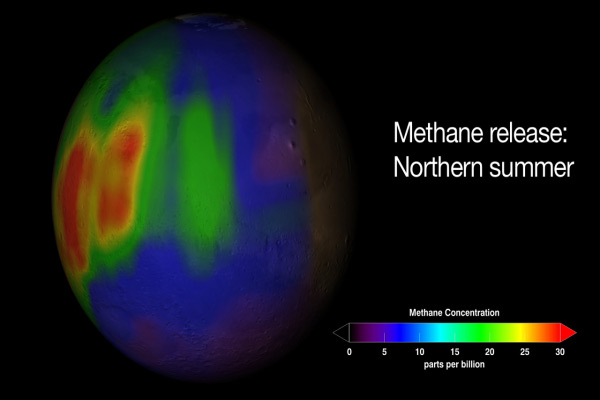
 Methane emissions, first recorded in 2003, emanate from Mars' surface even now, and have prompted many astronomers to say that the Red Planet is not yet dead from all standpoints, meaning that at least geological processes still have to be underway, in order for the gas to be pumped out. Some experts say that the releases could be triggered by ancient water trapped in various “bubbles” under the surface, while others argue that water may still flow beneath the surface. When this water reaches the heat of volcanoes, methane is produced, and that might account for why the phenomenon is being observed now.
"Methane is quickly destroyed in the Martian atmosphere in a variety of ways, so our discovery of substantial plumes of methane in the northern hemisphere of Mars in 2003 indicates some ongoing process is releasing the gas. At northern mid-summer, methane is released at a rate comparable to that of the massive hydrocarbon seep at Coal Oil Point in Santa Barbara, California," says NASA scientist Dr. Michael Mumma, working at the Goddard Space Flight Center in Greenbelt, Maryland.
"On Earth, microorganisms thrive 2 to 3 kilometers (about 1.2 to 1.9 miles) beneath the Witwatersrand basin of South Africa, where natural radioactivity splits water molecules into molecular hydrogen (H2) and oxygen. The organisms use the hydrogen for energy. It might be possible for similar organisms to survive for billions of years below the permafrost layer on Mars, where water is liquid, radiation supplies energy, and carbon dioxide provides carbon," Mumma adds.
From a biological standpoint, the fact that our neighbor releases methane has large implications. Biologists say that bacteria usually release the gas as a byproduct of their metabolic functions, which could mean that organisms located beneath the Martian surface could undergo some of the same basic life processes as their terrestrial counterparts do.
"Right now, we don’t have enough information to tell if biology or geology – or both – is producing the methane on Mars. But it does tell us that the planet is still alive, at least in a geologic sense. It's as if Mars is challenging us, saying, hey, find out what this means," the expert concludes.