 14 DAY TRIAL //
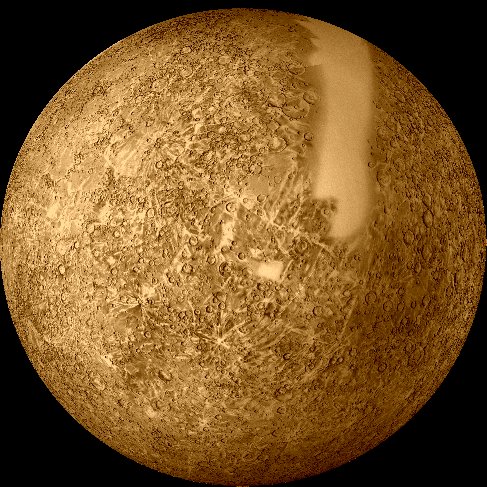
 Mercury is the smallest, most mysterious and closest planet to the Sun. In fact this so called 'mystery' is associated to Mercury also being the least studied planet in the solar system, which may seem kind of strange given the fact that it is relatively close to Earth as compared to the other planets beyond Mars' orbit. The first spacecraft to visit Mercury was NASA's Mariner 10 which, after three fly-bys during the 1970s, has detected the planet's magnetic field and mapped close to half the surface, amongst other investigations.
Mercury's inner regions are mostly made out of iron combined with small amounts of sulfur, which helps maintain a low melting point. However, somehow the planet's magnetic field is about 100 times less powerful than that of our planet, which cannot be accounted for with our current understanding of how planets generate their our magnetic fields.
Iron 'snow'
University of Illinois and Case Western Reserve University researchers believe that Mercury's mysterious magnetic field can be explained through an iron 'snow' that forms and falls towards the central regions of the planet, similar to the snowflakes forming on Earth during the cold season. "Mercury's snowing core opens up new scenarios where convection may originate and generate global magnetic fields. Our findings have direct implications for understanding the nature and evolution of Mercury's core, and those of other planets and moons", said University of Illinois geology professor Jie Li.
"Recent Earth-based radar measurements of Mercury's rotation revealed a slight rocking motion that implied the planet's core is at least partially molten. But, in the absence of seismological data from the planet, we know very little about its core", said University of Illinois graduate student Bin Chen, leader of the study.
The researching team prepared a multi-anvil apparatus to study the iron-sulfur mix in conditions of high temperature and high pressure, thus simulating part of the processes experienced deep inside Mercury's core. After being brought to the required temperature and pressure the sample was cut in two and analyzed with the help of a scanning electron microscope and an electron probe microanalyzer.
"Rapid quenching preserves the sample's texture, which reveals the separation of the solid and liquid phases, and the sulfur content in each phase. Based on our experimental results, we can infer what is going on in Mercury's core", explained Chen. According to the results of the experiment, the iron-sulfur mix in the outer core starts to cool and crystallizes into cubic iron 'flakes' which then sink to the central region under the action of the gravitational force. Molten sulfur-rich liquid then rises to the outer regions of the core, generating a weak magnetic field in the process.
"Our findings provide a new context into which forthcoming observational data from NASA's MESSENGER spacecraft can be placed. We can now connect the physical state of our innermost planet with the formation and evolution of terrestrial planets in general", Li said.