 14 DAY TRIAL //
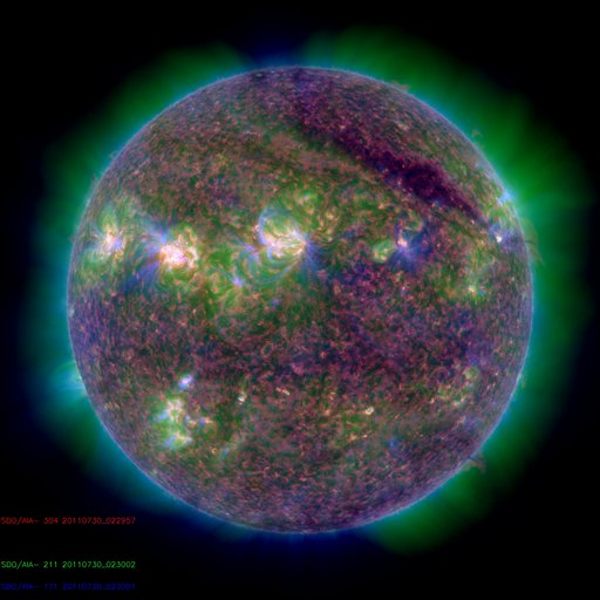
 The Sun released a very intense solar flare this weekend. The event was classified as an M9-class flare, which means that it was one of the most powerful phenomena of this type our star is capable of.
Experts say that the brunt of the storm was not aimed at our planet, which means that there is nothing to fear from the massive amount of radioactive material that was ejected. Furthermore, the event only lasted for a brief period of time, despite its intensity.
Official data indicate that the solar storm was produced late on Friday, July 29, at 10:09 pm EDT (0209 GMT on July 30). Shortly after the event first developed, it rose in intensity, only to disappear a short while later.
According to the Sun-monitoring website Spaceweather.com, it would appear that the phenomenon was accompanies by a relatively large geomagnetic storm. However, there appears to be no connection between the two, as the storm was most likely triggered by variations in the solar wind.
The event originated in the AR 1261 sunspot cluster, one of two such formations currently on the Sun. Constantly, these areas are producing solar flares of varied intensities, which are all recorded by multiple solar telescopes.
“Because of its brevity, the eruption did not hurl a substantial cloud of material toward Earth. So far none of the eruptions has been squarely Earth directed, but that could change in the days ahead as solar rotation turns the sunspots to face our planet,” the space-weather monitoring website explains.
Keeping an eye on solar flares is extremely important because highly-energetic radiations released from the Sun can severely affect our planet. Transformers, power grids, satellites and the International Space Station (ISS) could all be jeopardized by power surges.
Most of these radiations would be deflected by our planet's magnetosphere. However, when the solar flare is strong enough, the material can overwhelm Earth's defenses and plunge to the surface, drenching everything in ultraviolet rays and high-energy particles.
Solar physicists usually classify solar flares in three groups. The first, Class C, is the weakest. Class M storms such as the recent one are of medium-to-high intensity, whereas Class X events are the most powerful the Sun is capable of.
Our parent star is being constantly monitored by satellites such as the Solar Dynamics Observatory (SDO), STEREO, SOHO and so on. Together, they are providing a nearly uninterrupted flow of data to Mission Controls around the world, Space reports.