 14 DAY TRIAL //
 Scientists at NASA believe that they may be able to use the Mars Science Laboratory (MSL) rover Curiosity to gain more insight into the interior of the Red Planet. This can be achieved indirectly, by having the robot image solar eclipses as they take place.
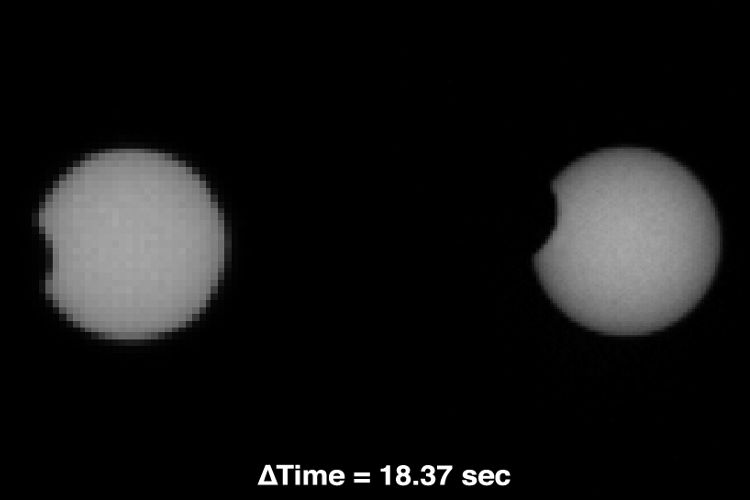
The new use was discovered only a couple of days ago, when Curiosity imaged the passing of the Martian moon Phobos in front of the Sun. Using its Mast Camera (MastCam) instrument, it was able to snap a series of images of the event.
The partial solar eclipse took place on Thursday, September 13. Mission controllers at the NASA Jet Propulsion Laboratory (JPL) in Pasadena, California, were expecting to see it. However, they were unsure as to when the event might actually start.
Determining when an eclipse will begin can only be done precisely if critical data about the planet's interior are known. In the case of Earth, this information is available. However, when it comes to Mars, there is still some uncertainty.
By comparing the time when the eclipse should have theoretically begun with the time it actually did, experts will be able to gain a wealth of data related to how the motions of the planet influence the event. In turn, this may be used to gain deeper knowledge of the Martian interior.
“We can't go inside Mars, but we can use these to tell how much Mars is deformed when the moons go by. So we measure the transits very precisely, we get information on Mars' interior structure,” Mark Lemmon explained, quoted by Space.
The expert, who is based at the Texas A&M University, holds an appointment as a co-investigator on the Curiosity science team. He made the statement during a press briefing yesterday, September 19.
One of the things that is becoming increasingly clear about Mars is that the planet will eventually destroy the diminutive Phobos, which is only 22 kilometers (14 miles) in diameter.
“It will work its way in at some point and get so close that tidal forces from Mars will very likely break it up before it does start grazing the atmosphere and come down. So Mars may briefly have a ring system,” Lemmon concludes.