 14 DAY TRIAL //
 After performing the first of two planned course-correction maneuvers on Thursday, August 30, scientists managing the NASA Juno mission decided to delay the second engine burn by 10 days.
Originally scheduled for Tuesday, September 4, the second engine burn was delayed until September 14, so that experts at the NASA Jet Propulsion Laboratory (JPL), in Pasadena, California, get the chance to look over the telemetry the probe relayed after the first thruster firing.
The two maneuvers are required in order to set Juno on a course that will take it past Earth in 2012. The goal is to perform a gravity assist (slingshot) maneuver that would boost the probe's speed considerably, and reduce the time it needs to get to its destination.
Upon browsing through Juno data from August 30, JPL scientists found that the 30-minute burn elevated fuel pressure in the propulsion system to higher-than-expected levels. The 10-day delay will give them the time they need to assess their next steps.
The maneuver consumed no less than 376 kilograms (829 pounds) of fuel. Telemetry relayed back to Earth via the NASA Deep Space Network shows that the spacecraft correctly entered its new course, Space reports.
The engine burn began at 6:57 pm EDT (2257 GMT), and succeeded in changing Juno's speed by 770 miles (1,240 kilometers) per hour. Despite the great distance between Jupiter and the Sun, NASA shone radioisotope thermoelectric generators (RTG) in favor of solar panels, as a power source.
“The team has decided to take an extra 10 days to analyze this increase and consider mitigation options, placing the second deep space maneuver on September 14. There will be no impact to the mission's timeline or science,” NASA announced two days ago.
Before achieving orbital insertion around Jupiter (currently scheduled for July 4, 2016), the probe will carry out a flyby of Earth on October 9, 2013. At closest approach, the spacecraft will fly just 310 miles (500 kilometers) above the surface, a little higher than the International Space Station.
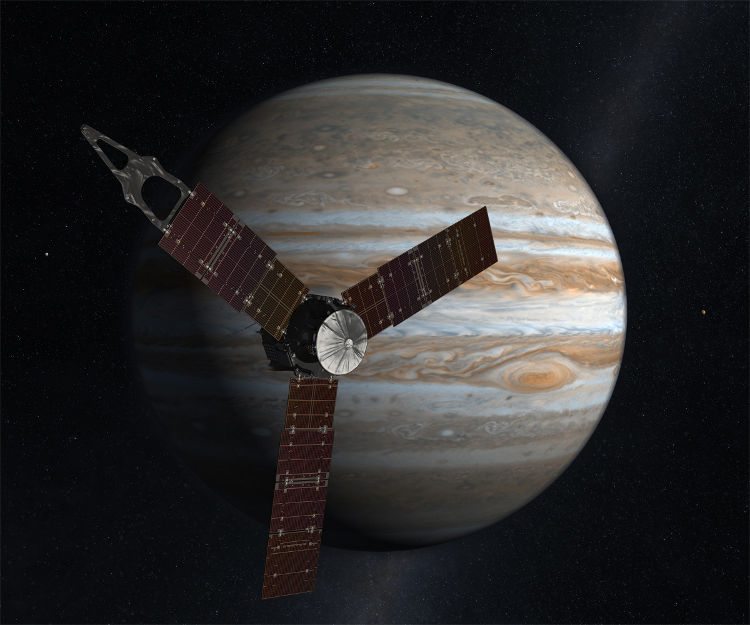
After the slingshot maneuver, Juno's speed will increase by 16,330 miles (26,280 kilometers) per hour, enough to get it to Jupiter in less than three years. Once at the gas giant, it will use its suite of eight scientific instruments to peer below the thick cloud cover obscuring the planet below.