 14 DAY TRIAL //
 When it comes to robots, so far, the Japanese rule. They're a few generations over the Americans and a century over any other competitor in the field. Sony's AIBO was the first robot dog that recognizes words and objects.
Honda's ASIMO is a humanoid robot, standing at 130 centimeters (4 feet 3 inches) and weighing 54 kilograms (119 lbs.). The robot resembles a small astronaut wearing a backpack and can walk on two feet in a manner resembling human locomotion at up to 6 km/h (3.7 mph).
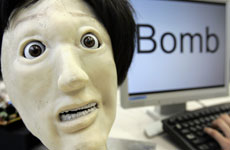
Now, the latest Japanese robot, developed by a university research team, is very...emotional. Called Kansei, it's equipped with 36 different facial expressions based on a program which creates word associations from a self-updating online database of 500,000 keywords.
It's an interesting thing here, the pre-programmed words being all in English, while its facial features are Asian. Maybe they just wanted to be understood by everybody.
Now here's the interesting part. The robot reacts to words by adopting the most suitable facial expression, which ranges from happiness to sadness, anger and fear. I don't know why, but he smiles when he hears the word "sushi," frowns at the word "bomb," and looks scared and disgusted when someone says "president."
The official explanation is the fact that when it hears the word "president," it makes its own connections between words in its database, such as "Bush," "Iraq" and "war," and creates an expression which the researchers said is meant to mix fear and disgust.
"What we are trying to do here is to create a flow of consciousness in robots so that they can make the relevant facial expressions," said project leader Junichi Takeno, a professor at Meiji University's School of Science and Technology. "I believe that's going to be a key to improving communication between humans and robots," he said.
Kansei is able to create the facial expressions with the help of 19 movable parts underneath the silicone face mask, and its makers say that it will also have speech abilities and will be able to convey feelings, in just a few years.
Practical applications of the robot can be envisioned, such as maid or workers in nursing homes for the elderly.