
Softpedia
 

NEWS CATEGORIES:


NEWS ARCHIVE >>
SOFTPEDIA REVIEWS >>
MEET THE EDITORS >>
TRENDING TODAY
Home > News > Technology and Gadgets > Systems

June 9th, 2012, 20:58 GMT · By

Intel’s NUC: A Handicapped MacMini Lacking Innovativity

SHARE:

Adjust text size:

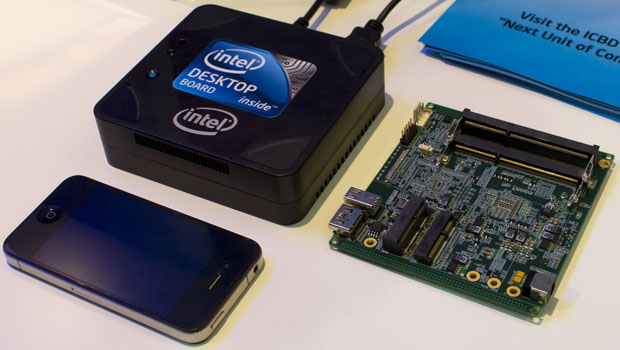
Intel's NUC system
Enlarge picture
Intel has again showed their company’s mini system called Intel NUC. The device is only 4” by 4” in size and that’s about 98 millimeters by 98 for European miniPC fans.

We’ve just presented VIA’s ARTiGO 1200 and the differences are considerable.

Intel’s NUC Core i5 processor is capable of reaching temperatures over 80 degrees Celsius while working on more serious tasks such as a flash game or doing more things at once like.

To our surprise, besides the cheap and dull design, NUC doesn’t bring any innovative useful features.

There’s no USB 3.0, there is no card reader and optical unit. There are no original features and no productivity or specialized additions either.

When talking about mini systems, productivity and versatility is are most important issues.

The system can only be this small and if the company’s goal is not to make a USB stick-sized device, we can’t see the difference in “smallness” between a 4” by 4” device with no versatility and a 7” by 7” device like MacMini.

VIA’s ARTiGO and Apple’s MacMini are bringing extended connectivity options, better build quality and much pleasant design with an overall versatility that should be envied by Intel’s NUC.

We would have liked to see an optical unit on NUC as we are completely against the trend of not really owning what you buy.

Storing media and data online is a useful idea for the ones on the go that want to have a centralized data storage unit, but not acceptable for movie and music collectors.

There are users that like to really own the media they buy.

A receipt allowing them to view it online when they are online or if they are able to connect to the server holding the file is not satisfactory nor a desired type of ownership.

The company should understand that without a special feature such a dual LAN, multiple USB connectors (six or eight), an optical drive, card reader and DVI along with miniDP and VGA we have almost no reason to consider buying it.

The one side where Intel’s NUC excels is performance. The i5 Core CPU is considerable more powerful than VIA’s Eden X2 and there are decent upgrade option such as a pail of SO-DIMM slots two miniPCIe expansions.

On the other hand, if we would be searching for performance we wouldn’t search for it in a mini system.

Besides the mandatory optical drive with slot loading that should not be missing from absolutely any PC system larger than a smartphone, we would like to see a card reader and six to eight USB 3.0 slots in any such device.

Diverse connectivity options like VGA, HDMI, DL-DVI, miniDP, eSATA, Thrunderbolt and WiDi should be present in all such devices.

So should be wireless connectivity with internal antennas and external connectors with concealing caps for bigger 10 dBi antennas.

After all of these, there should be different options to differentiate the product line such as multiple SO-DIMM slots, multiple (usually two) 2.5” HDD bays, dual LANs etc.

Accessories can also further differentiate this type of systems.

Some accessories like an external graphics card such as MSI’s GUS II or SONY’s external drive featured in the VAIO Z line would be great and innovative products.

A small battery pack to use the system as a wireless external HDD just like Patriot’s Gauntlet or IO Data’s new WirelessHDD should also be an option for the user to pay extra for.

On the 3D side, the ones interested in a little gaming on a SFF system will clearly go for AMD's Trinity or Brazos 2.0 that offer three to ten times the performance of Intel's HD3000.

Lacking innovative features, versatility, being handicapped on connectivity and bringing nothing original we have a hard time choosing it over mini systems based on AMD’s Brazos or somewhat larger SFFs such as MacMini or VIA ARTiGO.

Any user interested in versatility, gaming power, low power consumption, respectable design and a lower price will steer clear of Intel’s 400 USD NUC.

That’s about 320 EUR for the European “mini” fans.

With less gaming power than any miniPC based on AMD's Brazos 2.0 or Trinity, less connectivity, higher power consumption, less performance than MacMini, lacking design and innovative features, Intel's NUC is just a display of technological capability.

FILED UNDER:
intel
nuc
mini
sff
Computex 2012


6,530 hits · 9 comments
Link to this article · Print article · Send to friend

MUST-READ RELATED ARTICLES:


World’s Lightest UltraBook Pictured

HDD Market Oligarchy Continues: Seagate’s Net Income Increases by 1200%

Archos Arnova 7” and 10” Android 4.0 Tablets Just $172 USD (€136)

SSD Prices Fall Just as Predicted: OCZ Petrol Already at 0.5 EUR per GB

World’s Fastest Ivy Bridge Laptop Available Now

READER COMMENTS:


Comment #1 by: Arumes on 09 Jun 2012, 22:14 UTC reply to this comment

I'm getting tired of this Intel-bashing, even though most of my systems are based on AMD. Your job as a journalist is to bring the news OBJECTIVELY.
I already stopped reading Sebastian Pop for his extremely irritating style a long time ago. If I have to stop reading you as well, there's no reason to follow Softpedia's Technology newsfeed at all.


Comment #2 by: deeves on 11 Jun 2012, 14:21 UTC reply to this comment

I think you missed the point, the NUC is for embedded systems such as digital signage and kiosks... its not meant to compete with the mac mini


Comment #3 by: bork on 26 Jun 2012, 10:51 UTC reply to this comment

For those searching for performance in a mini system - and there are many, despite perhaps you, this is perfect and can't come to market soon enough.

Comment #3.1 by: Constantin Murariu on 26 Jun 2012, 13:22 GMT

Intel's NUC is indeed very powerful device for its size. The only criticism I've written was related to the features and usability of the device. Also about the pricing, design and build quality.

Performance wise, Intel's NUC is a respectable minicomputer.

Comment #3.2 by: Phil on 29 Aug 2012, 21:15 GMT

Constantin Murariu, apparently you don't know the market all to well. Either you've still live in the 2000s but with faster internet these days, optical drives are becoming more and more obsolete. The point of this system is to SHOWCASE what is possible given current technology and you're not limited to underpowered chips such as the VIA or the Intel Atom. OEMs builders like Foxconn or Zotac can use this initial design to make more powerful embedded PCs. Plus given the throughput of Thunderbolt, you can EASILY mimic the ports that you've been craving. You have to remember that with the size of the motherboard there are SPACE issues with all those components you want. By the sound of your complaints, I think you're very ignorant in the industry of component building. Also, I don't see this accomplishment as a stepback like you do, I see this as a step forward as the possibilities are limitless since you have a Core i5 in a very small form factor.

Comment #3.3 by: Constantin Murariu on 03 Sep 2012, 14:29 GMT

Apparently I stand corrected. ;)

P.S. If it's only a showcase system, then why did Intel offer pricing for it?

Comment #3.4 by: Phil on 10 Oct 2012, 17:20 GMT

I think as a writer, you need to familiarize yourself with the art of electrical engineering both designing and pricing. As a consumer we preach the words of: Small is great! The smaller the better! Now put on your Business hat and ask yourself, "What companies out there are offering something this small? How much did it cost us to build this? Is this targeted for the consumer market, OEMs, private businesses that will utilize this as an embedded machine?" Obviously the pricing is steep due to simple economics. Since Intel currently is the only supplier, they can set the price to make up for the cost and to earn a profit. As more companies such as Zotac, Asus, Gigabyte, just to name a few, start entering the market, the effect will drive costs down. Cost from PCBs manufacturing, capacitors going from $0.20 to $0.002 a piece, etc etc.


Comment #4 by: Dusty on 18 Jul 2012, 10:39 UTC reply to this comment

USD 400 price tag is wwaaaayyy to high, and lack of at least 1 Gigabit/sec hard wired LAN connectivity puts it out of the running for me. Ultimately I'd like to chain a couple of these together to do some high performance computing on my home lan - but thisdoesn't sound up to it and restricting it to small embedded systems really restricts its marketability (together with teh rediculous price). I will have to keep waiting...


Comment #5 by: Grammar Comedian on 26 Jul 2012, 13:25 UTC reply to this comment

I came here just so that I could laugh at the word "Innovativity"

Copyright © 2001-2013 Softpedia. Contact/Tip us at

WindowsGamesDriversMacLinuxScriptsMobileHandheldNews

SUBMIT PROGRAM   |   ADVERTISE   |   GET HELP   |   SEND US FEEDBACK   |   RSS FEEDS   |   UPDATE YOUR SOFTWARE   |   ROMANIAN FORUM