 14 DAY TRIAL //
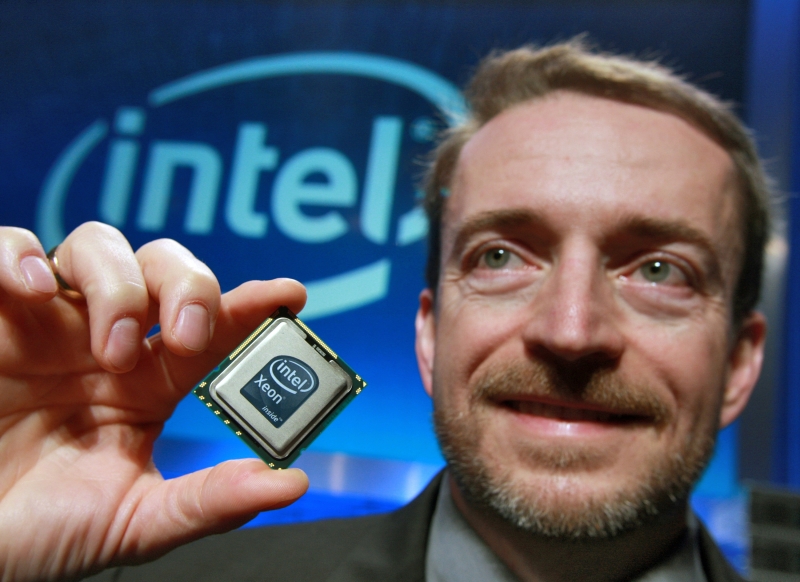
 Santa Clara, California-based Intel has just announced a new update to its line of enterprise-class Xeon processors with the introduction of the new Nehalem-based Intel Xeon processor 5500 series. According to the world's leading manufacturer of computer processors, this is its most revolutionary product lineup since its Pentium Pro family, released almost 15 years ago. Designed to meet the performance requirements of some of the upcoming supercomputers, these new Xeon processors include technologies such as Intel's Turbo Boost, Hyper-Threading and Intel's next-generation Virtualization Technology(VT).
“The Intel Xeon processor 5500 series is the foundation for the next decade of innovation,” said Patrick Gelsinger, senior vice president and general manager of Intel’s Digital Enterprise Group. “These chips showcase groundbreaking advances in performance, virtualization and workload management, which will create opportunities to solve the world’s most complex challenges and push the limits of science and technology.”
According to Intel, the new 5500 series of processors will enable a change in the Internet infrastructure, as an increasing number of users and companies will shift to the adoption of cloud computing. Thanks to the performance capabilities and power management features of Intel's new Xeon processors, major players in the IT industry will have the necessary tools to begin the development of cloud computing infrastructure.
One of the new features that have been enabled by Intel's latest Nehalem-EP processors is called Intel Turbo Boost Technology, which essentially increases the performance of the overall system, depending on the power requirements of the user's workload and environment. The technology dynamically boosts the processor's clock speed on one or more individual processing cores.
In addition to this new technology, Intel's new Xeon processors have been designed to allow users to effectively reduce the system's idle power, thanks to the implementation of improved power management that adjusts the power of the processor so that it meets the requirements of the overall system.
The new server processors provide a range of frequency levels that peak at 2.93GHz with 1333MHz DDR3 memory and power levels that range between 60 and 95 watts. However, with the use of Intel's Turbo Boost Technology, these frequencies can go up as high as 3.33GHz, depending on processor and system configuration. Intel's new workstation CPU can go up to 3.20GHz with power levels of 130watts, while the Turbo Boost Technology can increase that to 3.46GHz, depending on workload. Each of Intel's new processors is featured with 8MB of L3 cache.
With the launch of the new Intel Xeon 5500 series, the chip maker has also introduced some new embedded processors, including the L5518 and the L5508, designed specifically for the communications market segment. The former is designed to work at 2.13GHz and a power level of 60watts, while the latter is meant to provide a core speed of 2GHz and a power level of 38watts. In addition, the leading chip manufacturer also introduced the Intel 82599 10 Gigabit Ethernet Controller, which boasts an advanced virtualization technology and unified network support.
Price-wise, the Xeon 5500 series ranges from $188 to $1600 in 1,000 unit quantities, while the single-socket Intel Xeon 3500 series ranges from $284 to $999 in 1,000 unit quantities. The two embedded processors, the L5518 and L5508, are priced at $530 and $423, respectively, in quantities of 1,000 units.
