
Softpedia
 

NEWS CATEGORIES:


NEWS ARCHIVE >>
SOFTPEDIA REVIEWS >>
MEET THE EDITORS >>
Home > News > Technology and Gadgets > Audio

April 12th, 2007, 07:44 GMT · By

Instrument Engineering: Miranda's Travel Guitar

SHARE:

Adjust text size:


Both versions of a guitar
Enlarge picture
People have "traveled" everything and still they would not stop at anything: you have the travel TV, the travel blacksmith workshop, the travel steam iron and so may other things, some of them great, some of the monuments of ridicule.

It's time to introduce you the travel... guitar, from Miranda (Guitars, obviously). Until I saw the photos, I couldn't imagine it, but it's some weird fold-up-type of instrument, with a very weird shape and being actually - crap. Well, I must admit I was quite surprised, especially as I have seen that there are actual people playing this instrument and I have also listened to samples recorded using it.

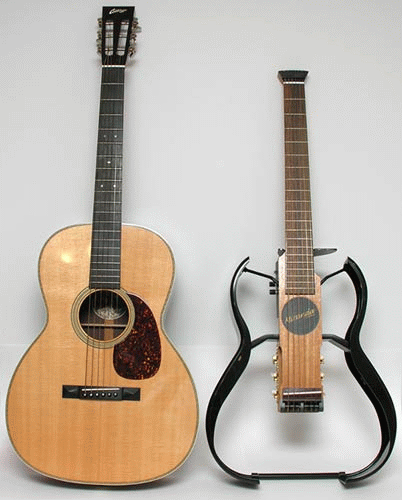
Basically, the Miranda Travel guitar is a classical guitar's mahogany neck, period. Of course, its shape and functionality had to undergo substantial changes as it had to be turned 180
degrees due to the tuning posts solution Miranda went for.

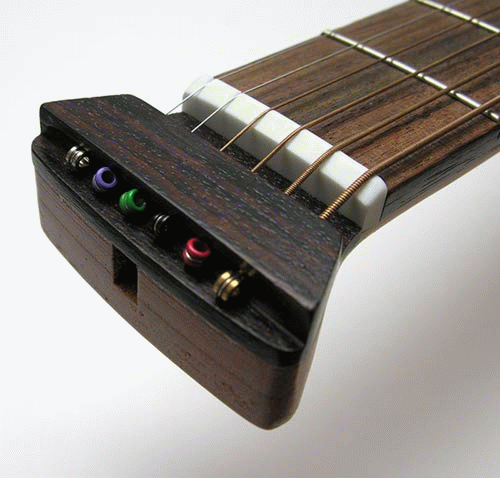
So, we have a guitar neck with no headstock and which acts like the solid body of a hollow-electrical guitar. The tuning pegs are in the actual middle of the guitar and this makes it substantially shorter in absolute size while retaining its normal scale.

As reported by Julia for The Gadgeteer (who has made a hands-on review on the Miranda), the placement of the tuning section is rather awkward and may be a pain in the neck for those guitarists not so willing to accept radical changes. Nevertheless, considering the overall craftsmanship and engineering approach, this is a thing a man can live with, definitely.

That's compact!
Enlarge picture
The Travel guitar has a hi-gloss, hi-impact acrylic "body"; I say body because it is the closest term to what it has exactly for the purpose. In fact, this body-thing looks more like the upper and lower sides of a usual classic guitar - very life-like indeed, creating the feel and touch of a real guitar: the playing position isn't different from what you'd meet in usual conditions.

The CFX-200 Miranda comes with included headphones; otherwise playing it would resemble very much playing an un-amplified electric guitar: hear only the slight buzz of the strings. The Output jack, though, will let you connect your travel guitar to amps and sound processors so here we have a perfectly-working piece of gear.

Ready to play in a couple of minutes
Enlarge picture
The aluminum rods which will hold the "body" in place are of course detachable, as the tapping pads are as well. This modular construction allows the "packed" guitar to occupy just a little more room than would a trumpet do: as a matter of fact, the CFX-200's case is some 3 to 4 times smaller and easier (weight-wise and carrying-wise).

It reaches playing status in just minutes and the sound is the same (except that it will require amps or headsets). The cost is somewhere to a low-end Larrivee acoustic guitar so the money is rather the same. If you were to buy a guitar yet still travel and want one on the go, what would you choose: the $1,200 "classic" guitar or the $1,195 Miranda? If you're yet undecided, here are some samples.

Aluminium and acrylic
Enlarge picture
All-sides view
Enlarge picture
The Mahogany no-headstock
Enlarge picture
Gotoh tuners placed underneath
Enlarge picture
Minimal electronics
Enlarge picture
Julia (the Gadgeteer) playing
Enlarge picture

TELL US WHAT YOU THINK:

3,643 hits · 2 comments · Link to this article · Print article · Send to friend · Subscribe to news

MUST-READ RELATED ARTICLES:


Gretsch to Make 59 Exact Replicas of Brian Setzer's 1959 Guitar

Add Image to Your Acoustics: Ellipse Aura from Fishman

Jimmy Page's Cloned (Guitar)

World's Ugliest Guitars

Your Acoustic Guitar on MIDI: Carvin NS1

READER COMMENTS:


Comment #1 by: Francesc on 14 Jul 2009, 09:29 UTC reply to this comment

I'm from Barcelona. A couple of years ago I adquired a CFX-200 Nylon-String Guitar. The idea of this guitar was not bad. The same size than a classical guitar. I paid more than 1200€ at that time. ABSOLUTELY DECEIVED.
1)They say "Neck width at the nut 52.3mm". This is true but the separation of nylon strings at nut was 44mm, the same than the steel strings model, all along the fingerboard. In this way they can use the same pickup used in the steel strings model. People, I can swear that if you stronly practice scales a week on this strings separation, you will need later another week to readapt your fingers to the standard classical strings width. Terrible.
2)Plastics easily broken. I have spent a lot of superglue to repair few parts.
3)The level balance of the 6 strings because the bad quality pickup system was unable. Always string one sounded less than the rest.
4)The earphones amplifier is mono: if you like to play the guitar over a stereo song or backingtrack, everything sounds mixed on your head, guitar and auxiliar input.
5)The 9v battery clip is not a professional choice. Easily broken.

Because the above reasons:
I spent a lot of money in a good luthier to substitue the original bridge saddle and nut by the standard width ones. I added a stereo earphones amplifier. I changed the 9v clip by a more professional system. I made a new acrylic heel plate tto reveal the cutaway, using aluminium. And finally I spent a lot of glue and patiente to repair the broken parts. I can show pictures about all I have said.

You better adquire a Yamaha SLG 120. Much better for less than half the price.


Comment #2 by: Miranda Guitars on 21 Dec 2011, 17:42 UTC reply to this comment

In over ten years of making and selling Miranda we have had only one disgruntled buyer. Now, you have heard from him. The gentleman from Barcelona bought his guitar in 2007, a nylon-string CFX-200. I will address the specific issues that he raised.
First, there is no right or wrong separation of strings at the nut -- it is a personal choice. I like the separation we use and have had no other complaints about it. He claims that it is the same as on our steel-string model. It isn't, and to my knowledge he has never seen our steel-string model.
He claims that the we chose a string spacing on the nylon string-guitar so that we could use the same pickup as on the steel-string. In fact, we chose that pickup several years before we even thought about making steel-string guitars.
We have not had any other buyer claim that they had difficulty moving from the Miranda to their acoustic guitar, and we hear from our buyers a lot, as our Comments page demonstrates.
Regarding the acrylic side panels: Unfortunately, at one time, without informing us, our plastic fabricator switched bonding agents on some units. We did have reports of a disbond problem, and had to recall and repair parts for several buyers. We did so free of charge and we absorbed all shipping costs. Happily, that is years behind us.
The gentleman from Barcelona decided to make major modifications to the bridge, saddle, and pickup of the guitar, unaware of the purpose of our design. We cannot be responsible for the results.
Regarding the monaural headphone driver, our purpose for including a line-in function was to enable playing along with a prerecorded guitar track, to facilitate learning. At that time, no other travel guitar had that feature. Making the output monaural enabled us to squeeze the rest of the electronics onto a board that would fit into the electronics case. As no one else has made an issue of this, we had no reason to reconsider.
As to the "unprofessional" battery clip, never had a problem with it.
We are rightly proud of our instruments.

Copyright © 2001-2012 Softpedia. Contact/Tip us at

WindowsGamesDriversMacLinuxScriptsMobileHandheldNews

SUBMIT PROGRAM   |   ADVERTISE   |   GET HELP   |   SEND US FEEDBACK   |   RSS FEEDS   |   UPDATE YOUR SOFTWARE   |   ROMANIAN FORUM