
NEWS CATEGORIES:


NEWS ARCHIVE >>
SOFTPEDIA REVIEWS >>
MEET THE EDITORS >>
Home / News / Webmaster / Tips and Tricks

Tips and Tricks


Installation of Apache Tomcat on Windows

Introduction to Java Server Pages

By Catalin Bocanu, Web News Editor

4th of March 2008, 15:42 GMT

Adjust text size:


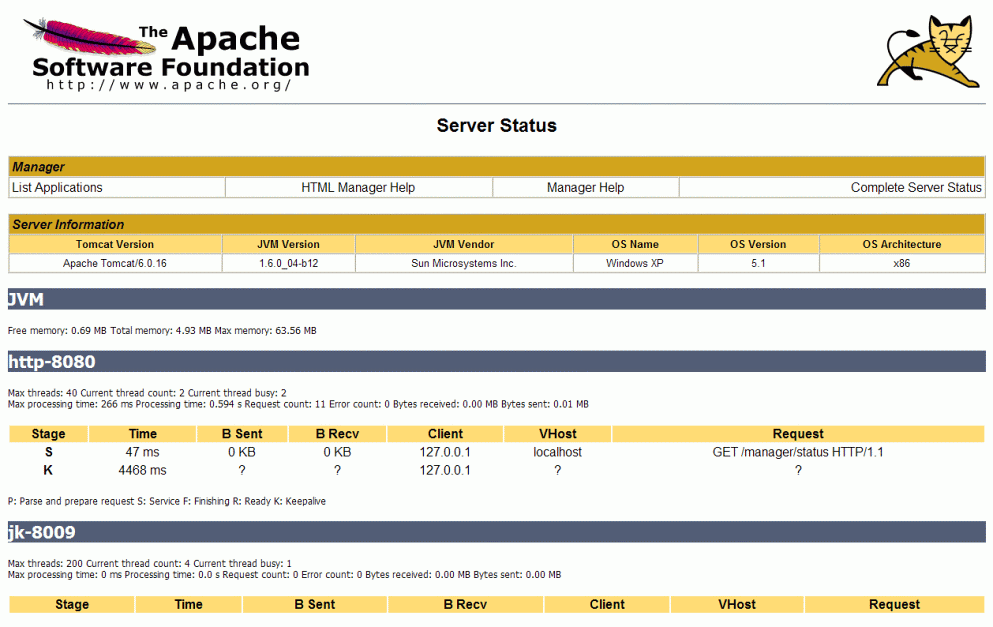
Server Status for Apache Tomcat
Enlarge picture
Many of the present web applications are created with a dynamic character by using a server side programming language. In principle, the dynamic web pages allow the separation of user interface by the content generation. There are many server side programming languages presently used
to develop complex applications.

Java Server Pages (JSP) allows the integration of Java code inside static HTML pages. JSP technology is developed by Sun Microsystems and permits the creation of applications running on server side. The Java code is contained inside special tags, but while the HTML, CSS or other static codes are processed by a web browser, the tags including Java code in a JSP file will be interpreted on the server.

If you want to start learning to make JSP applications, you will need to prepare the development environment. Free tools are available for any operating system, offering support to deploy and test JSP applications or scripts. For Windows operating system, the Apache Tomcat web server seems to be a reliable alternative.

First, you will have to install and download the latest version of Java SE Development Kit which provides the Java Runtime Environment (JRE) and other useful development tools. The JRE location is required by the Apache Tomcatinstaller for Windows and will be detected automatically. After you start the Apache Tomcat (installed by default as a Windows service), you should check if the installation was successful, by typing in your browser address bar:

CODE
http://localhost:8080

You should see the default Tomcat homepage. From the left menu, you can select to browse the Tomcat server documentation, test and view the sources of JSP examples and more. The port 80 must not be used by any other server previously installed, and, as a consequence, it is recommended to disable the automatic startup of other servers if they exist, in the same time with Apache Tomcat, on your Windows operating system. The extensive documentation, tutorials and resources related to JSP applications development existing over the Internet should help you to rapidly create your own JSP scripts.

TAGS:

Java Server Pages | JSP Scripts | Server Side Scripting | Dynamic Applications | Apache Tomcat
Read by 5,182 user(s) | Add comment | Link to this article TWEET THIS


Article rating:
Good (3.3/5) 6 vote(s)    

Subscribe to news | Print article | Send to friend

© Copyright 2001-2009 Softpedia
Contact:


SEARCH THE NEWS ARCHIVE :


Today's News
| Yesterday's News | News Archive


MORE RELATED ARTICLES:


Jaxer AJAX Server

Get A Free Visual Builder for Ajax Applications

PHP / MySQL Applications Performance

Mambo on Windows

Virtual Stores on Windows

How to Create an Executable PHP Script On Windows

A New Free Web Development Environment for Windows

Tips for Using PHP in Safe Mode

A Friendly Start for Learning TYPO3

Configure Any Apache Server from Windows Desktop

User opinions:

No user comments yet.
Be the first to express your opinion using the form below!

Share your opinion:

Your Name:
Your Email Address:
(will not be used for commercial purposes)
Solve this to prove you're not a bot: =
Your review/opinion:


Windows tabGames tabDrivers tabMac tabLinux tabScripts tabMobile tabHandheld tabGadgets tabNews tab

SUBMIT PROGRAM   |   ADVERTISE   |   GET HELP   |   SEND US FEEDBACK   |   RSS FEEDS   |   ENTER NEWS SITE   |   ENGLISH BOARD   |   ROMANIAN FORUM