
Softpedia
 

NEWS CATEGORIES:


NEWS ARCHIVE >>
SOFTPEDIA REVIEWS >>
MEET THE EDITORS >>
Home > News > Microsoft > Internet Explorer

March 8th, 2010, 14:59 GMT · By

IE8 Superior to Chrome 4, Firefox 3.5, Opera 10 and Safari 4

SHARE:

Adjust text size:


Internet Explorer 8
Enlarge picture
Internet Explorer 8 continues to be the best in breed browser when it comes down to offering end users security compared to rivals that, without exception, are considered to be more secure than IE by default in the public’s perception. It’s not the first time that IE8’s superiority over browsers such as Firefox, Chrome and Opera has been attested, for the protection that the browsers offer end users against socially engineered malicious code. According to NSS Labs, Internet Explorer 8 is capable of blocking at least approximately three times more malware than any of its rivals.

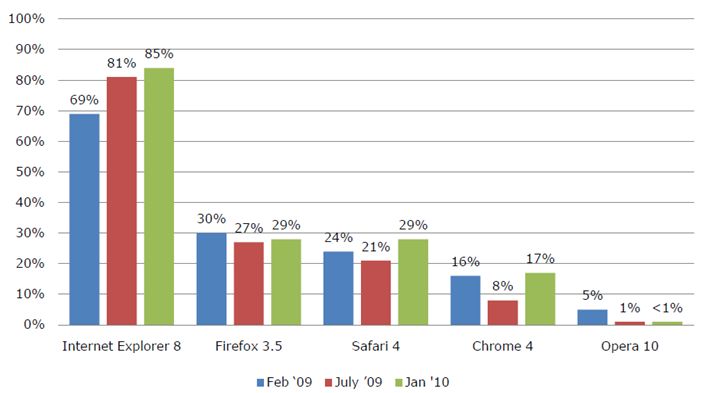
“Windows Internet Explorer 8 caught 85% of the live threats, an exceptional score which surpassed the next best browser (Apple Safari 4) by a 56% margin. Internet Explorer 8 improved 4% between the Q3 2009 and Q1 2010 tests, maintaining its leadership,” NSS Labs reveals. IE8 blocked 81% of all socially engineered malware in the last quarter of 2009, and 69% in Q1 2009. The percentage growth of course reflects the evolution of the browser itself in terms of the security it is capable of offering users.

IE8 comes with the SmartScreen Filter, a security feature designed to protect customers from web-based attacks. According to statistics from Microsoft, no less than one in 250 downloads is malicious code, and the end user has been tricked into downloading malicious code and infecting the computer. Eric Lawrence, IE program manager, offered an insight into the work that made IE8 the best choice for staying safe while online against socially engineered malware.

Block rate: socially engineered malware
Enlarge picture
“Since we launched IE8 in March 2009, SmartScreen has blocked over 560 million attempts to download malware, recently averaging over 3 million blocks per day! Hosted in datacenters around the world, SmartScreen’s URL Reputation Service (URS) has evaluated over 250 billion URLs to help keep IE8 users safe from malware. Even more impressively, since IE7’s Phishing Filter was introduced in 2005, the URS has processed over 5.7 trillion requests to block malicious web sites. Every day, Microsoft receives around 300 million telemetry reports from IE8 users and processes 4.1 billion URLs looking for malicious websites and files. On the back end, our systems and analysts evaluate over 1 terabyte of binaries every day to help identify sites delivering malware,” Lawrence stated.

Google Chrome 4, Mozilla Firefox 3.5, Opera 10 and Apple Safari 4 were all bested by Internet Explorer 8, according to NSS Labs. However, Microsoft underlines that IE6 and IE7 deliver no protection against socially engineered malware, and stresses that users of older versions of Internet Explorer should consider upgrading to IE8 as soon as possible. “Apple Safari 4 caught 29% of live threats, far fewer than Internet Explorer 8,” NSS Labs added. “Overall protection improved greatly from Q3 2009, with Safari providing 0.2% greater protection than Mozilla Firefox 3.5 in the current test. Mozilla Firefox 3.5 caught 29% of live threats to put it in a statistical tie with Safari 4. Both Firefox 3.5 and Safari 4 achieved this protection while utilizing the Google Safe Browsing API. Google Chrome 4 caught 17% of live threats, up 9% from the Q3 2009 test. Opera 10 caught less than 1% of the live threats, providing virtually no protection against socially-engineered malware.”

Firefox 3.6 Final for Windows is available for download here.

Google Chrome 4.0 Stable is available for download here.

Opera 10.50 is available for download here.

Internet Explorer 8 (IE8) RTW is available for download here (for 32-bit and 64-bit flavors of Windows XP, Windows Vista, Windows Server 2003 and Windows Server 2008).
TELL US WHAT YOU THINK:

6,735 hits · 7 comments · Link to this article · Print article · Send to friend · Subscribe to news

MUST-READ RELATED ARTICLES:


The Anti-IE: Firefox 3.6, Opera 10.50, Chrome 4.0, Safari 4

IE6 RIP – IE9 Comes into Focus

IE8 Fully Compatible with 90% of Websites Worldwide

Internet Explorer 9 (IE9) on the Bleeding Edge

Opera 10 Gets Best 2010 Browser Pick over Firefox, Chrome and IE8

READER COMMENTS:


Comment #1 by: mors on 08 Mar 2010, 16:48 UTC reply to this comment

These reports smelled like rotten fish from the 1st day, so if one investigates, this comes as interesting

http://my.opera.com/haavard/blog/2009/03/26/malware-report-from-nss-labs-manipulates-statistics
To quote
- Safari 4 and Firefox 3.1 were left out, while IE8 RC, a non-final version, is allowed
- The report says that 7% of the threats were blocked by all browsers, but Opera is claimed to have blocked only 5%
- They started out with 150 000 URLs, but ended up with only 492 in the final test
- Out of the 492 final tests, the same site could have up to 10% of the URLs, meaning that in a "worst case scenario", 10 unique sites were tested! If a browser did particularly well on one of these sites making up more than 10% of the test, their score would obviously be inflated (the report mentions that a number of sites were pruned after reaching their limit)
- According to the "Malware URL Response" table on page 3, Opera catches 15% on hour 0, and 33% after 5 days. And yet the final rate was set to only 5%
- According to the same table, Chrome consistently catches 25% or more, but the final score is only 16%
- The same table shows that IE8 never reaches 69% even once in the table, and yet its final score is raised to 69%
- On the other hand, IE7 has a total score of 17% in the table, but the final score is lowered to 4%

And I did my own analysis, considering their document http://nsslabs.com/test-reports/NSSLabs_Q12010_GTRBrowserSEM_FINAL.pdf
- they have not made the list of urls used for testing public -> this is a major issue, while makes their research basically useless
- they have used an initial couple thousand urls from the *IE* phising database (not officially recognized though, need to find reference)
- during testing they reduce the number of urls used to account for the final results (arguably to make some browser to stand out?) (page 7)

Lots of the data beween reports does not reflect normal protection patterns.
In this report http://nsslabs.com/test-reports/NSS Labs Browser Security - Socially Engineered Malware Q3 2009.pdf opera has the best time of 5.5 hours to add new blocks, while on another report http://nsslabs.com/test-reports/NSSLabs_Q12010_GTRBrowserSEM_FINAL.pdf it is 82 hours (!!?).
Notice that Opera also gets roughly 50% against phising, but >1% on malware protection. Given that the blocked urls that Opera uses come from Thawte, Netcraft, and Phishtank, this smells fishy. Actually, it almost seems like all those three sources are useless. Also, both Mozilla and Chrome are using Google for their blacklists. What magic is Microsoft doing that makes them so much better than anything else ?

Anyways, this is more of a big Microsoft sponsored study than anything else. Nothing to see here, just the same deceiving tactics, but this time someone else was was paid to say it.


Comment #2 by: Ubuntu4life on 08 Mar 2010, 16:52 UTC reply to this comment

IE is NOT the best browser.
Its the worst.


Comment #3 by: CHaagensli on 08 Mar 2010, 18:30 UTC reply to this comment

I've been saying it all along. The only reason the rivals are "more" secure is due to the market. It's obvious that more are willing to target IE when theres far more users. It's the same story along with Mac OS X and Windows too, the only reason windows gets heat in public perception is due to market share and compitability.

Windows have so many drivers, and support so much hardware, it literally just pisses all over Mac OS X, and the more code, the more vulnerabilities and exploits - obviously. And then theres the market share, why would anyone wanna create a trojan for Mac OS when they can create a trojan for Windows and have far more users to target. Not to mention, that all computer newbies use Windows.


Comment #4 by: Max Davis on 08 Mar 2010, 23:09 UTC reply to this comment

This study was funded by Microsoft. Fact. Look it up.


Comment #5 by: skypirate on 09 Mar 2010, 12:15 UTC reply to this comment

are you kidding me?! internet explorer and best security?!?!? ahahahahahahhaha
just with activeX i can hack into people's computers and EVEN change the speed their fans spin....
internet explorer is the most bloated, slow, insecure browser out there and its a matter of time it loses to Chrome/Chromium and Firefox


Comment #6 by: Charles on 09 Mar 2010, 12:31 UTC reply to this comment

The MS hate is so predominant here. You don't want to give IE 8 any credit at all. Yes, it is not the fastest browser doing java, it does not support the latests drafts of CSS and HTML 5 that are still in the works. But Microsoft, as the maker of the OS most attacked by malware and criticism has to have learned a thing or two about how to combat it. MS security essentials was given praise and caught more malware than then old veteran anti-virus makers. And I use IE 8 and I know is secure. The guys that criticize it here don't even use it. The fact is that most of the other browsers do not even have a focus in protection against social engineering threats, so why should they be better? Countering a scientific study with a blog from a competitor is not the best way. Why don't Google or Apple or Mozilla refute these findings, why some other security firm refutes it? They have the money, they could sponsor their own. So I rest my case. Give credit when is due and stop the hate.


Comment #7 by: nforce3 on 11 Mar 2010, 08:38 UTC reply to this comment

are you kidding me?
IE = worst.

Copyright © 2001-2012 Softpedia. Contact/Tip us at

WindowsGamesDriversMacLinuxScriptsMobileHandheldNews

SUBMIT PROGRAM   |   ADVERTISE   |   GET HELP   |   SEND US FEEDBACK   |   RSS FEEDS   |   UPDATE YOUR SOFTWARE   |   ROMANIAN FORUM