 14 DAY TRIAL //
 Many observations on the animal behavior confirm that "animals just lack speech".
In 1972, researchers witnessed an astonishing event involving wolves. A limping individual headed towards an abandoned den. His shoulder bore a deep wound. The next day, the researcher saw a big black male entering the den and regurgitating a big chunk of meat to the wounded animal and left. This maneuver repeated for several days till the wounded individual could rejoin the pack.
This was real altruism, and ethologists say that we have to look for the origin of the human sentiments.
Observations made on both howler monkeys or chimpanzees revealed how females of the group gather around a female who has just given birth to examine the newborn, trying to touch it or take it in their arms. Pretty human?
Chimps' behavior is a mirror of our own: from the organized hunting of the males to their hand gestures, which are exactly like the human ones, from bagging, greeting or hugging to shaking hands or even kissing the hand?
And all these in the same situations in which people use them.
One old chimp was known to make his daily siesta behind a tree, far away from the noise and the agitation of the young, in a royal solitude?Recent observations even showed how chimps employ "spears" to hunt small animals or use caves for sheltering.
Animals too have greeting behaviors. Their greeting has the role of establishing the sex and/or the rank of the greeted individual. When two dogs meet, they sniff each other's snout and genitalia, rather to detect the rank of the other. The one which accepts the first to be sniffed is letting itself be dominated. If the dogs already know each other, they lick each other's snout. But if they approach each other with the tail tensed (right, a little raised), this means that the hierarchy is not established yet and a fight can occur.
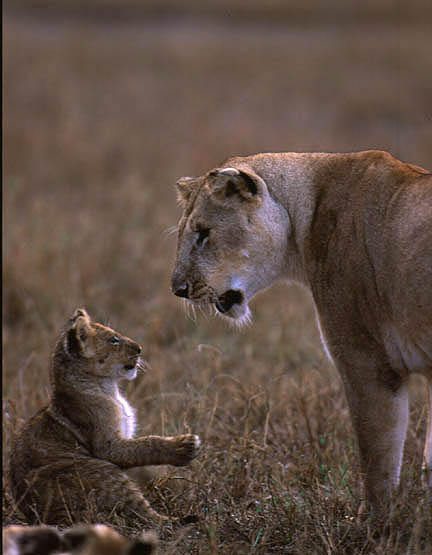
The offspring of the animals play in a way that is very similar to that of humans. Lion cubs play with the Tails of the adults, or the dolphin offspring play with shells, which they throw with their fins and reject with their fluke. The play fights in the case of the animal offspring have the role of establishing a hierarchy, which once established can be forever.
When wolf offspring reach 'adolescence', their rank is already established in the pack, and fights for the rank disappear. At the beginning of spring, all lion males are extremely irritable and the fights are frequent. After this period, the birth season follows. When the cubs have 10 weeks, the mothers bring them into the pride and one leads her offspring to an elder male, which probably is the father.
All males, young and old, gather, sniff, touch and exam the offspring after which they go. Immediately after that, all the irritability and the fights inside the pride are gone.
Like in humans, the birth of a new generation creates new rapports. We could not say if the lions love their offspring, but certainly the cubs have a sedative, calming effect in the family, whose bounds are strengthened.
But do animals have reason? Can they really analyze a problem and resolve it? Apparently, they do. Primates especially excel at it.
Researchers used to feed Japanese macaques by throwing over pebble soy and wheat seeds. In 1956, a young female took a punch of seeds mingled with sand and shells and dropped it in the water, probably by carelessness. The seed remained at the surface, the rest went to the bottom, so she ate the clean seeds. From then on, she repeated the operation daily.
The macaques nearby started to gradually imitate her and today, the habit is spread in the entire group of macaques, being transmitted from parents to offspring: already a cultural trait.
In chimps, these cultural traits in different populations are also associated with the use of tools, like the termite fishing by straw of the chimps from Gombe National Park (Tanzania) or palmnut cracking using stones on Ivory Coast chimps.
It seems that animals even "understand" death. It is known that elephants mourn for days the corpse of a beloved individual.
In chimps, the body of a death individual is usually surrounded by the other members of the groups, who start moaning together the deceased in a violent, acute tone, almost as people lament the loss of a friend during his/her burial.