 14 DAY TRIAL //
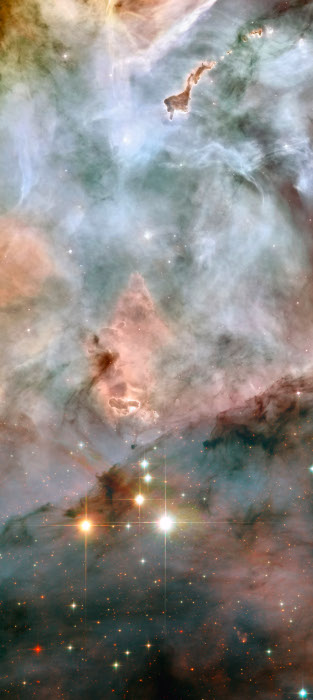
 The inner secrets of a pair of the most luminous stars ever discovered are finally revealed. The Hubble Space Telescope was able to take an unprecedentedly high detail picture of the stars in the Carina Nebula, lifting the veil (of gas and dust) from their faces. Much to the surprise of the team of astronomers, the brightest of the stars in question was itself actually made of three stars. This comes on the heels of a similar discovery related to the bright star at its left made two years ago, which showed it was in fact comprised of two stars.
The celestial bodies in question, called WR 25 (right, middle of the image) and Tr16-244 (the smaller one to its upper left), are located in the open cluster Trumpler 16, which is part of the Carina Nebula situated 7,500 light-years from the Earth (the leftmost bright one is actually much closer to the Earth). These are “live fast, die young” stars, which will burn their hydrogen fuel during tens or hundreds of millions of years (by comparison, our 4.6 billion-year-old Sun is in its mid-life stage).
Normally, stars situated at a big distance are easy to detect individually, but this type of middle-distance orbiting stars was a feat for Hubble's Wide Field Camera to detect. The images indicate that out of the three stars that form Tr16-244, two of them are in very close orbit around each other, while the third is very far, as it takes hundreds of thousands of years to complete an orbit around its companions.
Researchers are interested in these stars as they provide more insight on nebula formation, which in turn affects galaxy evolution and structure. "We are interested in massive stars because these objects exert a tremendous influence in their surrounding with their ionizing radiation and their powerful winds," explained Jesus Maiz Apellaniz from the Instituto de Astrofisica de Andalucia in Spain in an email to Discovery News. "When they explode as supernovae, they scatter the heavy elements they have produced in their interiors into the interstellar medium."