 14 DAY TRIAL //
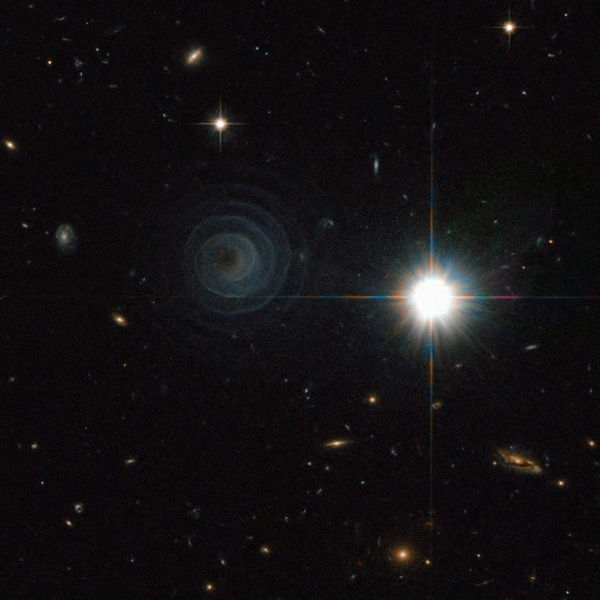
 Scientists using the Hubble Space Telescope have recently identified a cosmic spiral that has a nearly perfect geometric shape. The object is not a spiral galaxy, but rather a projection nebula.
With the help of the Advanced Camera for Surveys (ACS), the international research team managed to catch a glimpse of the carbon star called AFGL 3068.
The celestial fireball is surrounded by a massive cloud of cosmic dust and gas, which is heated to about 300 degrees Kelvin. This means that the star is invisible in visible light wavelengths.
This is why the ACS was used. Its broadband filters at 0.6 and 0.8 micrometers were capable of piercing through the cloud, and identified the spiral preplanetary nebula.
The structure itself is located in the constellation of Pegasus, around AFGL 2068 (aka LL Pegasi). The nebula has been dubbed IRAS 23166+1655. Astronomers do have a way with catchy names.
According to expert Mark Morris, a professor in the Department of Physics and Astronomy at the University of California in Los Angeles (UCLA), the thin pattern winds with great precision from the star.
It winds about 4 to 5 times around its point of origin, occupying an area of the sky ranging between 2 and 10 arcsecs.
The material itself has an estimated speed of about 50,000 kilometers per hour, and the research team says that, most likely, a regular, periodic origin exists for the layers. This explains their geometry.
Similar quasi-concentric shells have been observed around preplanetary nebulae before, but researchers say that this nearly-perfect geometric shape is unique in astronomy.
The discovery also sheds new light on what happens to stars that are between half and eight times the mass of our own Sun.
They do not have sufficient mass to explode into supernovas at the end of their burning cycles, but they can produce such intricate cosmic structures as LL Pegasi.
This particular preplanetary nebula has yet to develop completely. A few more million years will be needed before it grows to its maximum size, and until the parent star emerges from its dusty cocoon.
The new work was supported by NASA through grants awarded to the UCLA and the Jet Propulsion Laboratory (JPL), which is based at the California Institute of Technology (Caltech).