 14 DAY TRIAL //
 The Galileo thermometer, or thermoscope, is a device named after the Italian physicist Galileo Galilei and designed to measure temperatures with a relatively good accuracy, although today it is mostly used as a decoration item. Unlike most classical thermometers, the Galileo thermoscope relies on the buoyancy principle, and on the fact that the buoyancy of objects floating inside a liquid depends on the density of the latter, thus on the temperature of the medium.
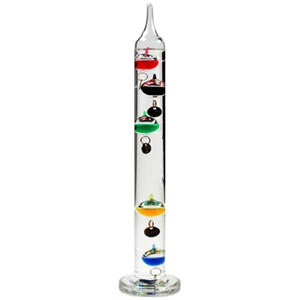
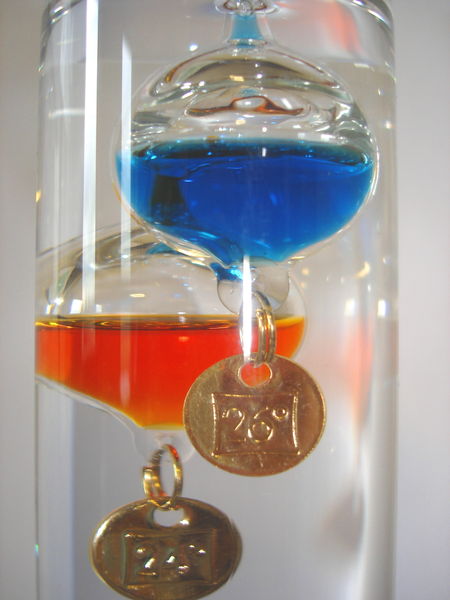
Basically, the Galileo thermometer consists of a sealed glass cylinder filled with a liquid containing a series of glass bulbs, all of roughly the same size and weight, partially filled with differently colored fluids. Calibrated weights, on which temperatures are written, are attached to the glass bulbs. The diameter of the sealed glass cylinder, those of the glass bulbs and the weights must also be calculated so that the bulbs do not jam themselves inside the cylinder. The bulbs are then stacked inside the glass tube according to their buoyancy.
How it works
As temperature variations occur in the medium, the liquid inside the cylinder starts to modify its density, which in turn affects the buoyancy of the glass bulbs. When the temperature falls, the density increases determining most of the glass bulbs to become more buoyant and move to the upper end of the cylinder. The opposite happens when the temperature of the medium starts to rise.
As earlier said, the temperature indication given by the Galileo thermoscope is only partially accurate, mostly due to the fact that a relatively low number of glass bulbs are used in its assembly (see lower image).
Measuring process
The temperature is measured according to the gaps that form between the glass bulbs. You can see in the lower image how the temperature level forced two of the bulbs to group in the upper part of the cylinder, while four of the bulbs sank to the lower end. The measuring process basically involves reading the temperatures written on the calibrated weights of the bulbs forming the gap (in the case of the lower image, the bubbles filled with yellow and green fluids), adding them up and dividing the result by two.
The temperature obtained through this process is most likely the closest to the real value. If there are no gaps between the bulbs, then the temperature is read directly off the calibrated weights. When all the glass bulbs move to the lower part of the tube, the one on top will provide the closest value to the real temperature. The opposite is true when all the bulbs group in the upper part of the cylinder.