 14 DAY TRIAL //
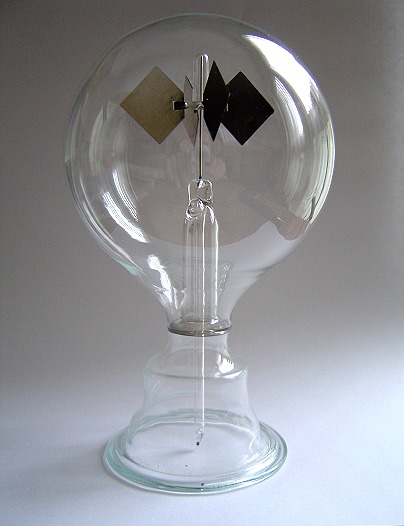
 The Crookes radiometer is a light mill consisting of a set of fins placed on a spindle that rotates inside a partially vacuumed glass bulb when exposed to light. The rotation speed is directly related with the intensity of the electromagnetic radiation, while the rotation direction depends on the temperature of the environment in which the device is placed. The force responsible for the rotation of the spindle has been subject to debate for many years, and although two components have been identified it is still unclear which one is stronger.
It was originally invented by Sir William Crookes, a British chemist and physicist, while doing quantitative chemical work in a partially vacuumed chamber. Allegedly, during his experiments he observed that when light shone on the balance the weighing process was disturbed, and chose to further investigate the effect. Later work eventually led to the invention of the radiometer bearing his name.
As previously said, in order for the device to work the spindle must be placed in a partially vacuumed chamber. If there is too much air inside the glass bulb, friction will prevent the fins from spinning as the forces acting on it are too small to overcome it. Alternatively, if the bulb is too much or completely vacuumed, the thermal transpiration, the effect behind the functioning of the device, will produce too little or no force at all and the fins will not spin. Therefore, a pressure of about 1E-2 torr is preferred in order to obtain maximum effects.
The fins themselves, or vanes, must be white on one side and black on the other. Usually, the white side is silvered while the reverse is made black. They rotate with the white or silvered side advancing and the dark side receding. The situation can be reversed when the radiometer is cooled. Heat will also make Crookes' radiometer spin, as infrared and near-infrared radiation is being generated by the surrounding bodies. Practically, in the absence of external electromagnetic radiation, the spindle can be put in motion solely with the infrared radiation generated by a person's warm hands.
How it works
As radiant energy comes from a particular light source, it warms the vanes on the black side at the same time causing the air molecules in the partial vacuum to heat up, to a temperature slightly higher than that of the medium. As heat is convected towards the glass bulb of the device and from the white side to the black one, the motion of the gas determines the fins to rotate.
Although it may seem like a device you generally see only in a museum, Crookes radiometers are in fact quite common and are sold across the world as novelty ornament. They have no known physical application and are only used to demonstrate the presence and the effects of thermal transpiration.