 14 DAY TRIAL //
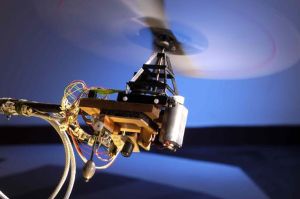
 Scientists have developed a robotic mini-helicopter employing a simple but effective visual trick used by insects in their flight.
The technique could potentially be employed to help control aircraft, but the research also explains how insects assess surroundings and land without crashing themselves to the ground.
As insects direct forward, the ground beneath them remains backwards of their visual field. The "optical flow" phenomenon informs the insects about speed and height: the higher the insect flies, the slower the optical flow; the faster it flies, the more rapid is the optical flow.
Optical flow is vital for landing: keeping a constant optical flow while going down should provide a constant height-to-groundspeed ratio, which makes a bee slowdown as it approaches the ground. Impairments in the optical flow make insects crash to the land.
A team led by Nicolas Franceschini at the University of the Mediterranean in Marseilles, France, has proven the same technique may be applied to more general flying behaviors: they suited a mini-helicopter with a simple software feedback loop that gave it a constant optical flow as the device flies along.
This technique made the mini-helicopter take off gracefully, keep constant altitude over various terrains and lands, all without devices measuring its speed or height. "The fact that insects are such effective fliers could all be thanks to a similar feedback mechanism hardwired into their brains", Franceschini says. "Maintaining a constant optical flow should be relatively easy for an insect," says Rob Harris, a specialist in insect vision at the Centre for Computational Neuroscience and Robotics and the University of Sussex, in Brighton, UK.
The constant optical flow eliminates the need for a manual height and groundspeed measurement. "You have to assume they are not doing complicated trigonometry in their little brains," he adds. "It explains about 70 years of experiments," Franceschini says.
Optical flow explains why bees often drown while flying over still water. As water's surface offers no visual traits, a bee can not employ optical flow and descends in the water. The team is designing optical flow regulators for aircrafts. "Such feedback mechanisms would be lightweight and trivial to develop and could help prevent crashes," he claims.