 14 DAY TRIAL //
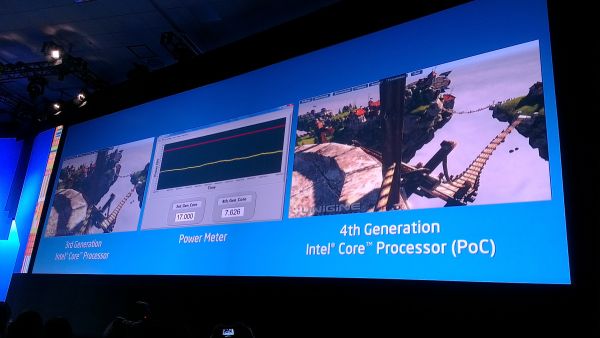
 During this year’s IDF event in San Francisco, California, Intel has demonstrated the performance and power consumption capabilities of its new Haswell processors, but the company is apparently putting power efficiency in the center of the stage.
Intel reportedly made an interesting demonstration at IDF where a 4th-generation Core processor using the new Haswell architecture was able to equal the performance exhibited by an Ivy Bridge Core i3000 series CPU.
The interesting aspect was that the Haswell chip was able to do this while using only 41% of the power needed by the Ivy Bridge CPU.
We already know that Haswell is not an x86 performance revolution and therefore we deduce that the company is mostly talking about the performance of the iGPU inside the Haswell processor.
This leads us to believe that the company actually completely adheres to AMD Rory Read’s “good enough” approach, like we reported here.
Many say that Haswell will bring less than a 10% x86 performance improvement compared with Ivy Bridge and therefore the rest is clearly related to Haswell’s considerably improved iGPU.
The Core i3 3000 Ivy Bridge family mostly has HD2500 iGPUs that are a lot slower than the HD4000 we can find inside the high-end Ivy Bridge processors.
Practically, a HD2500 iGPU is slower than what Sandy Bridge has with its HD3000 iGPU.
Intel itself compares the idle power efficiency of Haswell with the same aspect from Sandy Bridge.
Therefore, we can definitely say that Haswell is considerably more power efficient than both Sandy Bridge and Ivy Bridge, but the performance is actually comparable with Sandy Bridge and most enthusiasts and early adopters are not willing to take a step back.
On the other hand, we can only imagine just how powerful the 17W versions of Haswell will be. Still, the imagination shouldn’t go too far, as such a 17W processor will likely have an iGPU comparable with Ivy Bridge’s HD4000.
HD4000 performance inside a 17-watt TDP is nothing to sneeze at, but only the 35W and 45W models will actually bring the 200% performance increase that we reported here.