 14 DAY TRIAL //
 Though it's been five years since the devastating tropical storm that struck New Orleans and the entire Gulf of Mexico area, the effects that Katrina left behind are still obvious to the untrained eye.
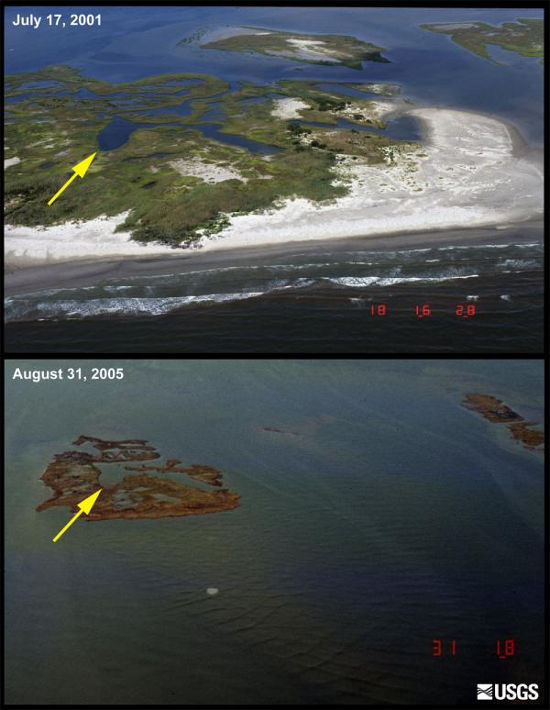
For example, in the remote, uninhabited Chandeleur Islands chain, located east of New Orleans, all sand dunes were completely wiped out by the massive air front.
“What happened there was extraordinary. After the storm, all of the dunes were completely destroyed. All of the sand was stripped from the islands,” says Abby Sallenger.
She is a coastal scientist based at the United States Geological Survey (USGS), and one of the investigators keeping an eye on what happens after Hurricane Katrina.
Though it made so many victims, the storm made most damage in the delicate ecosystems of the Gulf, including on barrier islands such as Chandeleur.
These were the first locations to experience the wrath of the massive atmospheric event, before Katrina made landfall in Louisiana, bringing with it storm surges 3 to 6 meters high.
When it touched southeast Louisiana on August 29, 2005, the event was a Category 3 storm, featuring winds of 200+ kilometers per hour. It killed more than 1,800 people, of which 1,500 in Louisiana.
"We talk about restoration all the time, but people that don't work on it 24/7 think we're going to put it back like it was before. But it's not about that, it's about making it better going forward,” says Denise Reed.
She holds an appointment as a coastal ecologist at the University of New Orleans. “The marshlands to the east of the Mississippi Delta were really hammered,” says Harry Roberts from the Louisiana State University in Baton Rouge.
But the situation is worst in the Chandeleur Islands because the entire chain threatens to be submerged entirely. These delicate ecosystems are apparently unable to recover from the floods they were subjected too.
Plus, they cannot replenish their sand dunes because dust doesn't make it to their location anymore.
Human pollution in the Gulf and around Florida is also of little help to promoting the recovery of these beautiful ecosystems.
But studies of how the situation evolves could help researchers devise better conservation efforts, OurAmazingPlanet reports.