 14 DAY TRIAL //
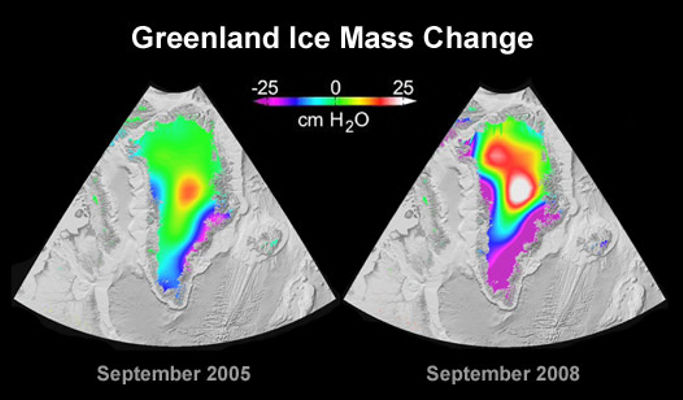
 An international collaboration of researchers has recently determined that Greenland is beginning to lose its ice sheets faster and also over more widespread regions than in the past decade. With datasets extracted from satellite study, and in-situ GPS measurements, the scientists were able to piece together an image showing Greenland's crustal uplift caused by ice-mass loss. Information collected by the NASA Gravity and Recovery Climate Experiment satellite system (GRACE) was instrumental for this particular study, experts at the Jet Propulsion Laboratory (JPL), in Pasadena, California, say.
Over the past ten years, the island has been experiencing a significant reduction in ice sheets, but most of the melting glaciers were located in its southern regions. This happened because these areas were bathed in the warmest oceanic water. But the recent study shows that the melting process is extending upwards, along Greenland's northwest coast, and that crustal uplift is becoming more and more obvious at previously-unaffected locations. This spreading process is believed to have begun in 2005.
“Our results show that the ice loss, which has been well documented over southern portions of Greenland, is now spreading up along the northwest coast,” explains the lead author of the scientific paper accompanying the findings, expert Shfaqat Abbas Khan. Full results have been published in the March 19 issue of the American Geophysical Union's (AGU) scientific journal Geophysical Research Letters. The group also included researchers from the University of Colorado in Boulder (UCB) and the Technical Institute National Space Institute, in Copenhagen, Denmark.
“When we look at the monthly values from GRACE, the ice mass loss has been very dramatic along the northwest coast of Greenland. This is a phenomenon that was undocumented before this study. Our speculation is that some of the big glaciers in this region are sliding downhill faster and dumping more ice in the ocean,” explains UCB Cooperative Institute for Research in Environmental Sciences fellow John Wahr, who is also a professor of physics at the university. Wahr was also a coauthor for the journal entry, alongside Ohio State University expert Michael Bevis and Eric Kendrickm and JPL scientist Isabella Velicogna. She also holds an appointment at the University of California in Irvine (UCI).