 14 DAY TRIAL //
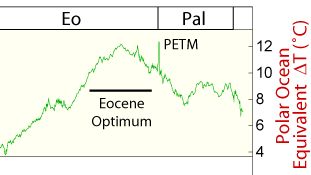
 Around 55 million years ago took place one of the most rapid and extreme global warming events recorded in geologic history. Sea surface temperatures rose between 5 and 8 degrees C over a period of a few thousand years. This event, called 'Paleocene-Eocene Thermal Maximum' or the 'Initial Eocene Thermal Maximum' (PETM or IETM), unleashed climate shifts that endured tens of thousands of years.
Scientists Flavia Nunes and Richard Norris of the Scripps Institution of Oceanography in California explored how these warmer temperatures might have affected ocean currents. They measured carbon-13 isotopes from 14 cores that had been drilled into the deep floor in four different ocean basins, taking samples from sediment layers deposited before, during and after the PETM. These isotopes are considered to be an indicator of the nutrients deposited by the water at the time. The higher the isotope value the likelier that the source came from the deep ocean, the prime source for nutrients. With a painstaking reconstruction, Nunes and Norris found that the world's ocean current system did a U-turn during the PETM -- and then, ultimately, reversed itself. Before the PETM, deep water upwelled in the southern hemisphere; over about 40,000 years, the source of this upwelling shifted to the northern hemisphere; it took another 100,000 years before recovering completely.
What unleashed the PETM is unclear. Most fingers of blame point to volcanic eruptions that disgorged gigatonnes of carbon dioxide, or coastal reservoirs of methane gas, sealed by icy soil, that were breached by warmer temperatures or receding seas.
The huge temperature rise may have occurred within just few thousand years, but as Nunes and Norris point out, the effects were enduring and the lesson for mankind today is clear.
"Modern CO2 input to the biosphere from fossil fuel sources is approaching that estimated for the PETM, raising concerns about future climate and circulation change," they warn. "The PETM example shows that anthropogenic (man-made) forcing may have lasting effects not only in global climate but in deep-ocean circulation as well."
The study comes on the heels of research published in November last year which suggests that global warming is slowing the Atlantic current that gives western Europe its mild climate. The suspected reason for this is an inrush of freshwater into the northern Atlantic, caused by melting glaciers in Greenland and melting sea ice, and higher flow into the Arctic from Siberian rivers caused by greater rainfall. The influx brakes the conveyor belt in which warm surface water is taken up to the northeastern Atlantic from the tropics before returning down to the southern hemisphere as cool, deep-sea water.