 14 DAY TRIAL //
 A recent contest, set up by aeronautics company Airbus, the creator of the largest passenger airplane in the world, the A380, has requested students around the world to come up with the most innovative planes of the future. Demands have not been very strict, in that the participants could base their ideas on technologies that have not yet been scientifically proven to work, but, naturally, the ones that could be constructed at this point have been favored. Among the five finalists, a US student from the Stanford University has brought forth the most interesting design.
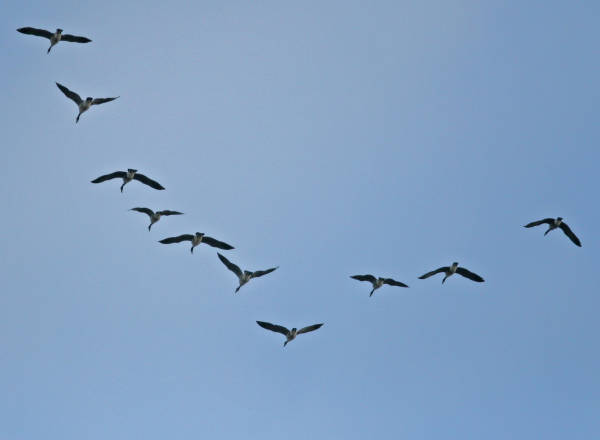
He advocates that tourists could be transported to their winterly destinations by passenger airliners flying in an “inverted V formation,” similar to that employed by geese, in order to travel extensive distances without rest. The main idea behind this concept is the fact that airplanes flying in such a formation would experience less drag, on account of the fact that the resistance set forth by air is displaced by the aircraft at the tip.
The others would simply have to slipstream behind it, and the airplanes could take turns in leading the formation. This would also save a large amount of fuel, as air companies say that drag is the main force that drives kerosene consumption up.
Anne Galabert, who is a spokeswoman for Airbus, said that, “This is not necessarily something we would exploit, but the idea and approach are interesting and the analysis is of high quality. People have looked at this and conventional studies are based on the ordinary V formation, but the innovation here is that the students are looking at a backwards V,” as Reuters reports. At this point, airplanes flying around the world have to maintain a certain distance from each other, on account of the fact that turbulences from the one in front could severely affect the one in the back.
But the new approach would eliminate this problem, and would ensure a steady motion through the air. Together with the other four finalists, the Stanford student will present the design in June, at the Paris Air Show, in front of a panel of judges. Despite the fact that it's cutting 10,000 jobs, EADS, the owner of Airbus, is currently looking to hire an additional 300 engineers, in a bid to remain competitive on a market that has moved forward at a very high speed over the years.
Other designs have included an aircraft without windows – which would annoy passengers, but would make the entire craft fly more efficiently with less fuel –, another one that would have its interior designed from castor plant natural fibers, as well as one that would use electrical motors, rather than kerosene-powered ones. Another suggestion, coming from a student in Singapore, relies on solar panels to power up the aircraft. Some 2,350 students in 82 countries have participated in the contest, and Airbus told that the winner would receive a grand prize of 30,000 euros (some $41,000).