 14 DAY TRIAL //
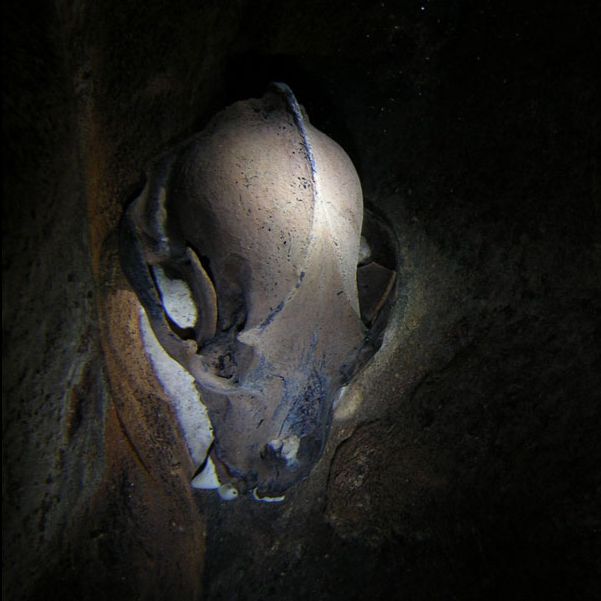
 Four complete skulls and jaws of a Pleistocene bear species called Arctotherium, that disappeared 11,300 years ago, were found by aquatic archaeologists in a submerged cave on the Yucatan peninsula in Mexico.
The 25-30 cm long skulls discovered at 42 meters underwater, belong to two adult bears - one of each sex - and two bears that had not reached full maturity.
The discovery was made by Guillermo de Anda Alanis and his team from the Yucatan Autonomous University, while they were diving in a cavern, as part of the project authorized by the National Institute of Anthropology and History (INAH) “El Culto al Cenote en el Centro de Yucatan” (Cult to Cenote in Central Yucatan).
Guillermo de Anda Alanis said that the fossils were found between the towns of Sotuta and Homun, in Yucatan, spread on a 120 meters diameter surface.
The four skulls seem to belong to a family of bears of the same species, because the 2 adult skulls belonged to a male and a female, and the 2 other did not reach full development.
The preliminary investigations of the fossils were made in situ, but further research is necessary, artdaily reports.
What is known until now, is that these are the only specimens of their type found until now in this region of the country, and they add to the few Prehistorical animals discovered in this type of water bodies, which were dry caves before glaciations.
These fossils challenge the biogeography of bears in the Americas, since Arctotherium was previously known to only have lived in South America.
De Anda said that at first the remains were thought to have belonged to jaguars, but archaeozoologist Christopher Gotz from Yucatan Autonomous University carried out the morphological identification of the skulls, and confirmed they belonged to bears, because of their strong, flat and wide molars.
Gotz said that species related to Arctotherium in America are the extinct North American short-faced bears(Arctodus simus and pristinus), the Florida short-faced (Tremarctos floridanus), the Mexico short-faced (Tremarctos mexicanus) and the last survivor that lives in South America, the Andean short-faced bear (tremarctos ornatus).
Besides the bear fossils, the archaeologists also found skeletal remains of five humans, and further dating of these skeletons should establish if the two discoveries are connected.
De Anda said that “this research is only beginning, and it will most likely provide important data for the knowledge of the first species that inhabited the region, as well as of the historical periods to which human remains yet to be analyzed belong.
“We are looking forward to confirm after analyses that the remains correspond to that genus, since it would enlarge the knowledge regarding this animal’s natural history and their relation with their closer relatives.”
He announced the details of the discovery at the International Congress American Cultures and their Environment: Perspectives from Zoo Archaeology, Paleo Botanic and Ethno Biology, organized by the Yucatan Autonomous University in Merida, Yucatan.