 14 DAY TRIAL //
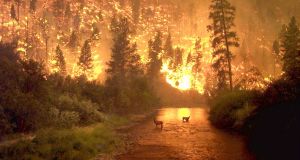
 Global warming has already brought more droughts and longer summers to the Earth's vast northernmost forests, and this phenomenon increased the number of forest fires.
Many think that increased amount of carbon dioxide into the atmosphere will trigger more warming, and this one more fires and so on - a vicious climatic cycle.
But one team has reached the conclusion that in fact, on middle term, forest fires will provoke in fact a cooling due to ecological succession.
"The reflectivity effect in the long run is larger than the carbon effect," said Michelle Mack, a UF assistant professor of ecology in the botany department.
The study agrees that "carbon sequestration" plans will work.
"Indeed, reducing atmospheric carbon is generally a good idea," say Ted Schuur, a UF assistant professor of ecology in the botany department.
Rather "What we're showing," Schuur said, "is that if you are going to manage an ecosystem to have an effect on the climate via carbon sequestration, you need to consider all the other climate forcing factors you may be changing at the same time."
Boreal forests, also named taiga, stretch over 5.7 million square miles, or 14.5 %, of the earth's land surface. They store 30 % of the planet's carbon in plants and soils.
Global warming hits hardest near the poles and on boreal forests.
The research team focused on associated climate effects of fires brought by warming climate, on short (one year) and long (till 80 years) periods.
They measured the carbon amount released in the burning of black spruce, the most common tree species in North American boreal forest, and of the re-growth species wood but also the exchange of carbon dioxide between boreal soils and the atmosphere and the albedo (the amount of light reflected by a surface) of the spruce, burned soils and broad-leaved re-growth trees.
Field observations and satellite data were modeled into a computer, to see the results along 80 years.
The first year following fire was warmer, due to added carbon dioxide resulted from the burning.
But within 10 to 15 years, the climate would cool.
The first trees growing on the burnt taiga were aspen, birch and other deciduous trees, with broad light-green leaves, with a higher albedo than the dark green, thin-needled black spruce's leaves, thus more heat was reflected into the space.
More over, in the winter, the deciduous trees lose their leaves, revealing the white snow, which has the highest albedo.
"The black spruce would eventually grow back, but it will take a long time to dominate the deciduous trees and reduce the reflected light," the researchers said.