 14 DAY TRIAL //
 A group of experts confirmed the existence of an exoplanet that was formed outside the Milky Way, but which was brought into our galaxy as its star was engulfed during a galactic merger. The finding has tremendous implications for the field of astronomy.
The announcement was made on Thursday, November 18. The astronomers behind the discovery say that the parent star for the newly-found planet was most likely formed in a nearby galaxy billions of years ago, and that it made its way here after the Milky Way engulfed the other galaxy.
This process may have taken place anytime between 6 and 9 billion years ago, scientists now believe, and it was only chance that brought the planet within the range of astronomical observatories, Space reports.
Until now, no one has been able to confirm the existence of exoplanets around stars in other galaxies, mostly due to the distances involved. This is what makes the new finding all the more precious. A body born elsewhere in the Universe has been brought fortuitously right in our backyard.
“This is very exciting. We have no ability to directly observe stars in foreign galaxies for planets and confirm them,” explains Rainer Klement, who is a coauthor of the new investigation. The expert is based in Heidelberg, Germany, at the Max-Planck-Institut fur Astronomie (MPIA).
As soon as the planet was discovered, astronomers realized that this particular body could change their theories about how planets form, and about how much beating they can take from their star before they are destroyed.
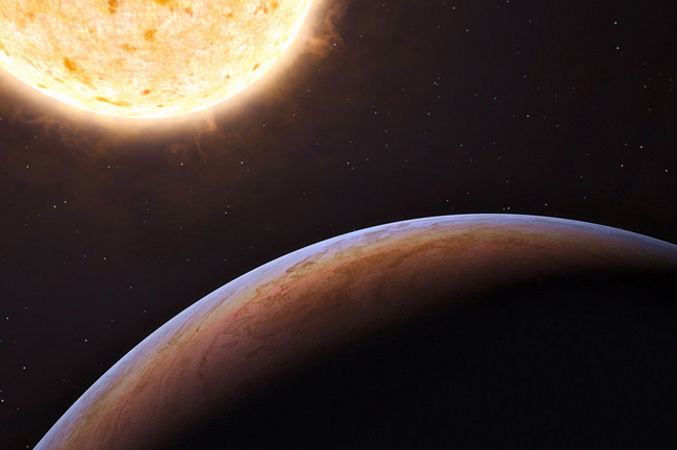
This particular exoplanet, which has been dubbed HIP 13044b, resides around a star that is extremely old, and also metal-poor, which means it features only negligible amounts of chemical elements heavier than hydrogen and helium.
In fact, it would appear that this planet is very resilient. Its parent star has long since passed through its red giant phase, which is when the stellar outer atmosphere engorges and enlarges by a large amount.
When the Sun will pass through this stage, its surface will nearly reach Mars, destroying Mercury, Venus and Earth entirely. HIP 13044b was apparently able to survive disaster in its own system, astronomers say.
The really interesting fact is that the exoplanet is not located far away from its star. In fact, one year there is the equivalent of 16.2 Earth days, and the distance at closest approach between the two bodies is just 5 million miles.
Additionally, the planet is about 25 percent more massive than Jupiter, which places it in the gas giant category. The system lies some 2,000 light-years away, in the direction of the constellation Fornax.
The age of that star system also raises some tantalizing questions. “You can think of the very first stars in the Universe, or the second or third generation of stars. Could they already have been able to form planets?” Klement says.
An analysis of how this star system can help us better understand our own is available here.