 14 DAY TRIAL //
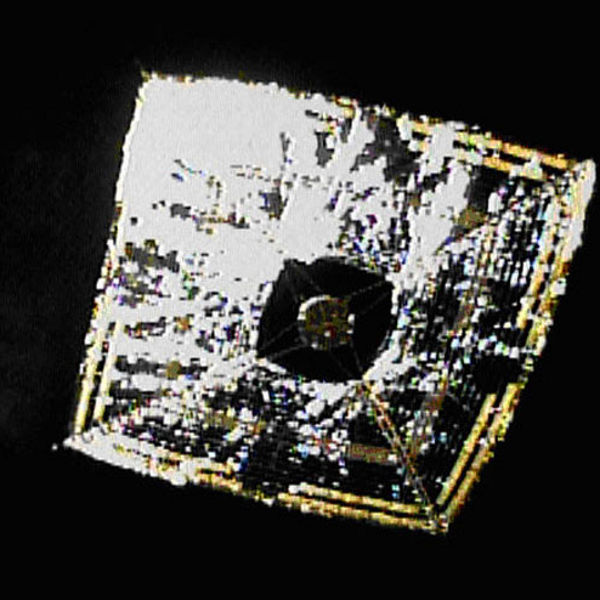
 Experts at the Japanese Aerospace Exploration Agency (JAXA) announced recently that their first solar sail demonstrator, the Ikaros spacecraft, managed to accomplish its mission. They explain that the small instrument managed to deploy a thin solar sail, and then used it to harness the power of light for motion. A solar sail works in very much the same way as a regular sail does, except for the fact that it uses the energy of photons for motion, rather than wind.
Until Ikaros came along, there were a number of other projects meant to make solar sails a reality. The American space agency had its own program, and private companies participated in the race as well. However, it would appear that the Japanese managed to nail it first, as evidenced by the telemetry data they presented. The Ikaros vehicle was launched in May 2010, aboard the same H-IIA 202 rocket that also delivered the Venus-bound Akatsuki orbiter to Earth's orbit, Space reports.
The recent success JAXA and its machine registered is the topic of a three-day symposium that began Tuesday in New York. This is the second International Symposium on Solar Sailing, and it's currently being held at the New York City College of Technology. Physicists, astronomers, and a host of other experts from various fields are participating in the discussions, which seek to pinpoint possibilities and challenges associated with the development and wide-scale implementation of solar sails in future technologies.
“It should have begun with a famous New York ticker-tape parade for our colleagues from Japan who took us to this reality,” the co-founder of the Pasadena, California-based Planetary Society, Louis Freedman, says. This organization has been involved in developing solar sails in the past as well, but it failed to create a working prototype. In addition to mastering a forward motion, JAXA experts also showed that it's possible to use sunlight to change directions in space, without having to install thrusters aboard the vehicle. A lack of thrusters translates into a smaller launch weight, and into the possibility of installing more equipment on a solar sail-powered spacecraft.