14 DAY TRIAL //
 A group of researchers from the Netherlands has proven scientifically, for the first time, that graphite can be a permanent magnet at room temperature. The find could have significant implications for new types of electronic devices, nanostructures, and various types of regular and bio-sensors, the team reports. The discovery was made by scientists from the Eindhoven University of Technology (EUT) and the Radboud University Nijmegen (RUN), and is detailed in an online paper, published on October 4 in the respected journal Nature Physics.
EUT researchers Jiri Cervenka and Kees Flipse, together with RUN colleague Mikhail Katsnelson, were surprised to find ferromagnetic properties in graphite. In addition to determining the order, they also managed to provide an explanation for the underlying mechanism, the journal entry shows. Graphite is made up of graphene sheets, which are held together by weak, interlayer interactions. This means that the individual layers can easily be broken from each other, so the graphite is used as a basis for pencils, as well as for some types of lubricants.
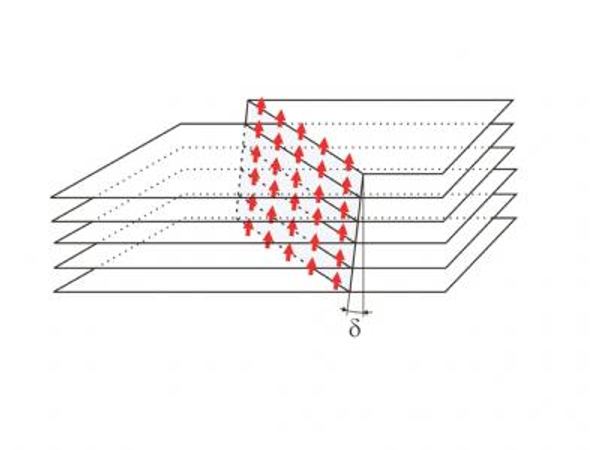
The team identifies 2-nanometer-wide boundaries of defects between highly ordered regions of carbon atoms as the main element that causes magnetic properties to occur in the material. They argue that the electrons in these defect areas behave differently than their counterparts in the ordered regions. Moreover, the team notes, this behavior is highly similar to the one exhibited by electrons in some ferromagnetic materials, like iron and cobalt. The team's studies were funded by Nanoned and FOM.
The new investigation opens up new avenues of research, especially in fields such as carbon-based materials spintronics. The team has determined that a material containing only a single carbon atom can also be weakly ferromagnetic. This type of behavior has never before been recorded in such a material, the experts say, and implies that spins could be changed by weak, magnetic fields in the future, and that they could travel relatively long distances without spin-flip scattering.
Huge applications in biosensors could also exist, as carbon is, in essence, an organic molecule. Because it exhibits a magnetic behavior, it could help power up new classes of biosensors, far more effective than current technologies.