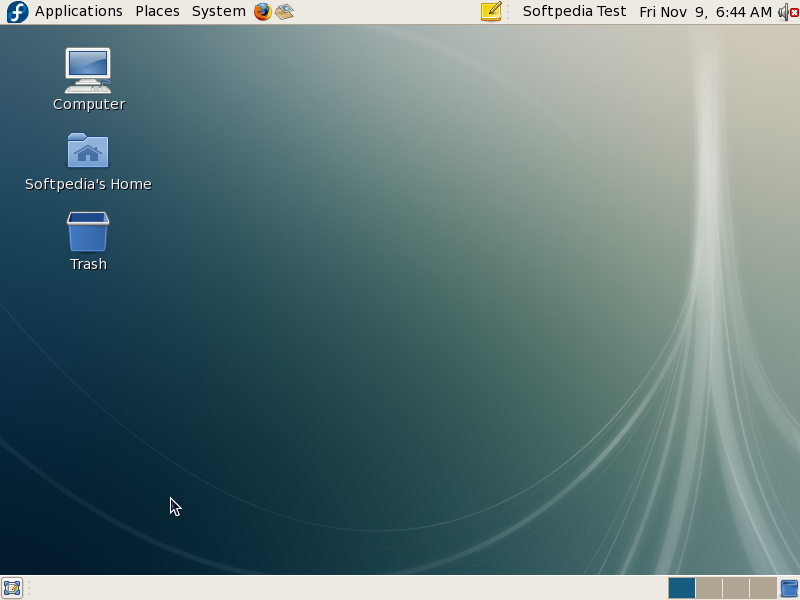

First alpha version of
Fedora 9 (codename Sulphur)
was released last night.
"A funny thing happened on the way into the office today, an Alpha release of Fedora 9 happened!" Among the numerous new technologies, improvements and enhancements found in F9 we can mention:
• GNOME 2.21 with GVFS
• KDE 4.0
• Firefox 3 Beta 2
• PackageKit
• Kernel 2.6.24
• FreeIPA
• Fast X
Also, the Anaconda installer received the following improvements:
• Support for resizing ext2, ext3 and NTFS partitions.
• Support for creating and installing to encrypted filesystems.
• Improved Rescue Mode (FirstAidKit).
• Allow the user to set the install source during the second stage of installation.
• Use libblkid for filesystem probing.
Remember that this is an alpha release and it should NOT be installed on production machines. It is intended to be used for testing purposes only. Please report bugs to the Fedora Bug Tracker
Ubuntu 8.04 LTS Release Schedule:
5 Feburary 2008 - Alpha release
13 March 2008 - Beta release
10 April 2008 - Preview release
<
22 April 2008 - Release Candidate 1 release
29 April 2008 - Fedora 9 Final release
About Fedora:
The Fedora Project is a Red-Hat-sponsored and community-supported open source project. It is also a proving ground for a new technology that may eventually make its way into Red Hat products. It is not a supported product of Red Hat, Inc.
The goal of The Fedora Project is to work with the Linux community in order to build a complete and general purpose operating system exclusively from free software. Development will be done in a public forum. The project will produce time-based releases of Fedora Core about 2-3 times a year with a public release schedule.
The goals for Fedora 9 are:
• Ongoing Bluetooth enhancements;
• Improve the support for multiple timezones/locations in the clock applet;
• Fix the proliferation of dictionaries in Fedora;
• Add ext4 filesystem support;
• Add built in encrypted file system support;
• Increase response time to 1 second from exec to accepting clients;
• Make fingerprint readers as easy as possible to use for authentication;
• Make Identity, Policy and Audit centrally and more easily managed;
• Update Fedora to gcc 4.3;
• Provide good support for Haskell development and use, with a high number of quality libraries and tools available;
• Integrate LTSP from K12LTSP project into Fedora and merge enhancements upstream;
• Replace KDE3.5 with 4.0 and upgrade modules;
• Expand the situations in which NetworkManager can be used and make it more robust;
• Provide alternative package management system;
• Partition resizing at install time;
• Allow users to depsolve and download only the pkgs they need to upgrade their distro while using the older version;
• Add Yum support for deltarpms;
• Move install selection to second stage of installer;
• Standardize server provides;
• Replace teTeX with TeXLive;
• Update X server to at least version 1.5;
• Replacement for SysVinit that allows service management and event-driven initialization;
• Extend remote authentication to use Kerberos and PAM;
• Enable virt-manager to run as a unprivileged user;
• Add the ability to list, create and delete storage volumes from a remote host using libvirt;
• Replacing the current forward-ported XenSource code on kernel-xen by a paravirt_ops based implementation, including dom0 support.
You can download Fedora 9 Alpha now from
Softpedia.
You can download Fedora 8 now from
Softpedia.
MORE RELATED ARTICLES:
How to Install Video Drivers on Fedora Core 6
Free Download of Yellow Dog Linux for Playstation 3
Fedora Core 6 Reached Its End
Fedora Weekly Report: 28th January - 3rd February
The Werewolf Packed with Games
Nine Features Included in Fedora 9
Virgin America Has Chosen Red Hat Enterprise Linux
New Head Under the Red Hat
The Werewolf Has Been Unleashed