
Softpedia
 

NEWS CATEGORIES:


NEWS ARCHIVE >>
SOFTPEDIA REVIEWS >>
MEET THE EDITORS >>
Home > News > Science > Space

November 19th, 2010, 09:36 GMT · By

Extragalactic Exoplanet Could Yield Clues to Earth's Fate

SHARE:

Adjust text size:


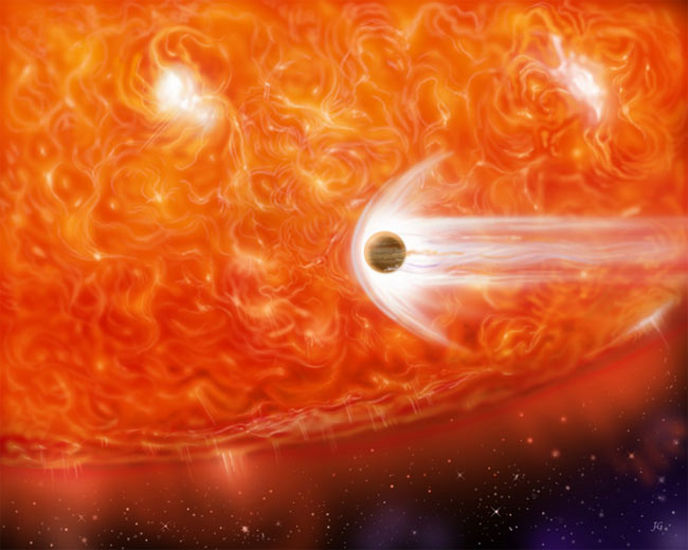
Artist's rendition of a swollen red giant consuming a gas giant exoplanet in its orbit. This will most likely happen to HIP 13044b too
Enlarge picture
Yesterday, November 18, astronomers announced the existence of an exoplanet that was “born” in another galaxy, and then was engulfed by the Milky Way. Experts now say that studying this system may yield some insight into Earth's ultimate fate in our own solar system.

Deeper studies of the exoplanet and its parent star could also help astronomers make more sense of how our solar system will look like once the Sun reaches the end of its burning cycle, turns into a red giant, and then finally into a white dwarf.

The exoplanet, called HIP 13044b, is a gas giant with a mass 25 percent larger than that of Jupiter. It orbits its parent star at a distance of just 5 million miles, which means that the length of a year there is just a little over 16 Earth days.

The star originated in a nearby dwarf galaxy some 6 to 9 billion years ago, and entered the Milky Way when our galaxy merged with the smaller one. Since HIP 13044 was born, it has already passed through many changes, Space reports.

For example, the star turned into a red giant many years ago, which means that its atmosphere expanded considerably, most likely engulfing the exoplanet entirely. Yet, that did not destroy the body, which is something astronomers did not though was possible.

What is more interesting however is that both HIP 13044 and the Sun are similar stars, which means that they developed in roughly the same way. The distant star is however farther along the evolutionary line.

This is why astronomers hope to use it to figure out how the Sun will behave in the next 3 to 6 billion years. It is estimated that our star will reach the red giant phase in about 5 billion years, after it exhausts its hydrogen supplies.

One of the things that astronomers find interesting about this star system is the fact that the orbit of the exoplanet was most likely a lot more distant from the star than it is today. Astronomers hypothesize that the red giant phase is what derailed the planet from its previous orbit, bringing it so close to HIP 13044.

The initial distance is probably what allowed the exoplanet to endure, experts believe. Had it been close to the star from the get-go, it probably wouldn't have survived the red giant phase.

In our own solar system, only Mars and gas giants will most likely escape the bloating of the Sun. The rest of the inner planets – Earth, Venus and Mercury – will be destroyed and engulfed by the Sun.

The remaining planets would then rearrange their orbits, and places such as the Saturnine moons Titan and Enceladus may look pretty much the way Earth looks today. They may become our new home a couple of billion years from now.

TELL US WHAT YOU THINK:

3,911 hits · 11 comments · Link to this article · Print article · Send to friend · Subscribe to news

MUST-READ RELATED ARTICLES:


First Extragalactic Exoplanet Found

Jupiter-like Exoplanet Reveals Hot Spot on Its Side

Exoplanetary Interactions Can Help Us Detect Them

'Second' Earth's Atmosphere Modeled

Exoplanet Around Binary System Poses New Questions

READER COMMENTS:


Comment #1 by: Spool Chucker on 19 Nov 2010, 11:29 UTC reply to this comment

Fate surely ?


Comment #2 by: Per Nikkity on 19 Nov 2010, 11:40 UTC reply to this comment

'Fate', perhaps...?


Comment #3 by: Tudor Vieru on 19 Nov 2010, 11:44 UTC reply to this comment

fate, yes, thanks.


Comment #4 by: susanchassit on 19 Nov 2010, 11:51 UTC reply to this comment

But what makes the writer think that 'we' will still be around a couple of billion years from now? What an absurd last sentence. It damaged the credibility of the entire article.

Comment #4.1 by: MrWoodward on 19 Nov 2010, 13:01 GMT

The comment which you suggest we wont be around in a bilion years completely descredits your statement too.

Wether we are or not around in a billion years none of us will ever know or can possibly answer with any degree of accuracy.


Comment #5 by: susanchassit on 19 Nov 2010, 11:56 UTC reply to this comment

'Experts now say that studying this system may yield some insight into Earth's ultimate faith in our own solar system.'

FAITH?

Fate. Yes, most certainly 'fate'.


Comment #6 by: Zarathustra on 19 Nov 2010, 12:18 UTC reply to this comment

I like the way the author has used the term "born". Many people who are unfamiliar with astronomy wouldn't be able to understand the term "formed".

It is fascinating that this is "something astronomers did not though was possible" (sic).


Comment #7 by: angelsriches on 19 Nov 2010, 12:19 UTC reply to this comment

Yet, that did not destroy the body, which is something astronomers did not 'though' was possible.

????????


Comment #8 by: jdiyef on 19 Nov 2010, 12:23 UTC reply to this comment

Tudor: I believe you mean "fate", not "faith", as in "clues to Earth's fate."


Comment #9 by: passer By on 19 Nov 2010, 12:32 UTC reply to this comment

You mean fate. Not faith.


Comment #10 by: indianacarnie on 23 Nov 2010, 08:04 UTC reply to this comment

yeah yeah yeah, syntax and all, i thought it was an interesting read. and i think its entirely possible to still be around as a species that far into the future. well , we wont be the "same" species by then haha but human all the same.

Copyright © 2001-2012 Softpedia. Contact/Tip us at

WindowsGamesDriversMacLinuxScriptsMobileHandheldNews

SUBMIT PROGRAM   |   ADVERTISE   |   GET HELP   |   SEND US FEEDBACK   |   RSS FEEDS   |   UPDATE YOUR SOFTWARE   |   ROMANIAN FORUM