 14 DAY TRIAL //
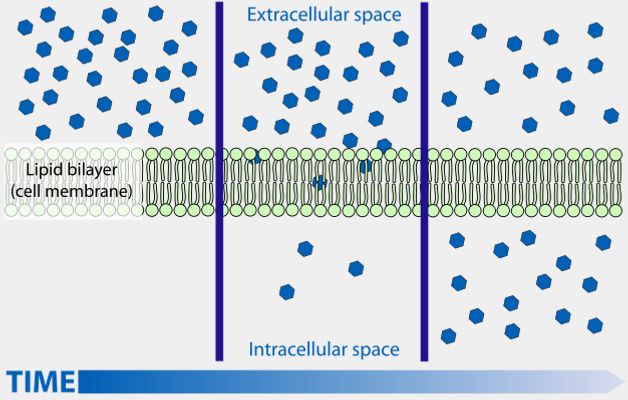
 Interactions at a cellular level are the things that drive all living things, according to biologists. All cells need to be able to communicate with the outside world, and the way they do that is by exchanging chemicals through their membranes. Regardless of whether we're talking about a brain cell or a single-cell microorganism, the basic principle is the same – chemicals go through pores in the membrane, on their way in or out. Now, experts have finally created the first artificial pore able to guide nanomaterials through membranes.
The innovation, designed and constructed at the University of Cincinnati (UC) Biomedical Engineering Department, consists of a nanomotor inside a lipid membrane. A nanomotor is a microscopic biological machine, which can propel itself through a medium. In their experiments, the UC team modified one such nanomotor, and then passed it through a lipid membrane. The resulting channel was large enough to allow for the passing of single- and double-stranded pieces of DNA.
The finds are detailed in a paper entitled “Translocation of double-stranded DNA through membrane-adapted phi29 motor protein nanopores,” published in the September 27 online issue of the renowned scientific journal Nature Nanotechnology. According to Peixuan Guo, PhD, the UC biomedical engineering professor who led the research effort, the finds could have significant implications for nano-sensing, gene-delivery therapies, drug-loaded nanoparticles, as well as DNA sequencing.
“The re-engineered motor core itself has shown to associate with lipid membranes, but we needed to show that it could punch a hole in the lipid membrane. That was one of the first challenges, moving it from its native enclosure into this engineered environment,” the co-first study author, David Wendell, PhD, who is a UCBED research assistant professor, says. “Since the genomic DNA of human, animals, plants, fungus and bacteria are double stranded, the development of single pore system that can sequence double-stranded DNA is very important,” Guo concludes.