 14 DAY TRIAL //
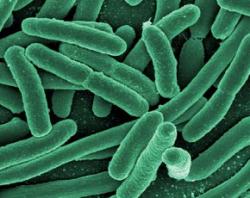
 Some two decades ago researcher Richard Lenski of the Michigan State University started growing 12 laboratory populations out of a single Escherichia coli bacterium, which has evolved for over more than 44,000 generations ever since, thus accumulating even more genetic mutations. Although all 12 populations evolved separately they seemed to present similar features, experiencing a rise in growth rate and a decrease in numbers, until the 31,500th generation when something unpredictable happened.
Though all populations have been fed with glucose, one of them suddenly mutated in order to metabolize citrate, which, usually, is of no use to E. coli bacteria. In fact, precisely because the E. coli is known to be unable to metabolize citrate, it's this inability that stands as one of the indicators used to identify it from other bacteria. Evolution had taken place right in front of Lenski's eyes.
"It's the most profound change we have seen during the experiment. This was clearly something quite different for them, and it's outside what was normally considered the bounds of E. coli as a species, which makes it especially interesting", he said.
As soon as the mutation took place, the features of the population started to change in relation to the other ones, by increasing diversity and number. Meanwhile, the number of generations showed that the bacteria went through all the possible simple mutations not only once but several times, suggesting that the metabolizing of citrate is not triggered by a simple, single mutation but by a highly unlikely one, such as a chromosome inversion.
Since Lenski had stored population samples every 500 generations finding the respective mutation should have been relatively easy, although time consuming. The problem was that nothing could ensure that the respective population would again mutate in order to metabolize citrate. After reviewing several trillion cells, Lenski realized that the mutation that gave rise to E. coli bacteria capable of metabolizing citrate took place after about 20,000 generations and was activated 10,000 generations later.
The experiment led by Lenski is probably the best example showing that evolution doesn't always provide the best outcome, since only one of the populations managed to mutate and it is yet another piece of evidence that evolution took and is still taking place. "The thing I like most is it says you can get these complex traits evolving by a combination of unlikely events. That's just what creationists say can't happen", said Jerry Coyne of the University of Chicago.