 14 DAY TRIAL //
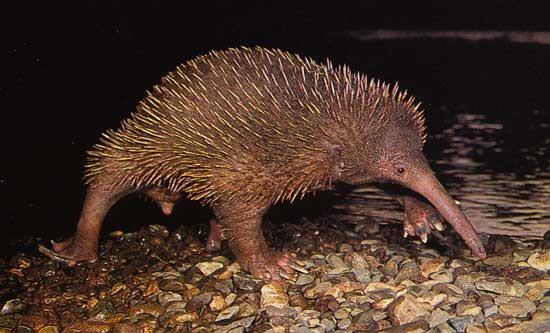
 This living fossil was thought to have been extinct. Till recently, an expedition on Papua's Cyclops Mountains revealed that the egg-laying mammal, baptized after the famous TV naturalist Sir David Attenborough, is still alive, as proven by burrows and tracks.
Attenborough's long-beaked echidna is known to science only through a 1961 specimen, found in a Dutch museum. The month-long expedition made by a team from the Zoological Society of London (ZSL) covered parts of the mountain range, passing through thick jungle unexplored for over 45 years.
"We hope that Sir David Attenborough will be delighted to hear that his namesake species is still surviving in the wilds of the Papaun jungle." said Jonathan Baillie, ZSL's Evolutionarily Distinct and Globally Endangered (Edge) program manager.
The species had not been recorded since a Dutch botanist found the only known specimen in the cloud high mountain forest of the Cyclops Mountains in 1961, so that it was believed that the shoe box-sized species (Zaglossus attenboroughi) had disappeared. Ice Age Australian relatives of the creature were sheep sized.
But local tribespeople said they have spotted the species as recently as 2005. The biologists also found "nose pokes", holes made in the ground by the echidnas while searching for their food, earthworms.
"Attenborough's echidna is one of five monotremes (egg-laying mammals) that first inhabited the Earth around the time of the dinosaurs. This group includes the duck-billed platypus, which helps demonstrate how different these are from all other mammals." wrote Baillie in the program's blog.
Another reproductive peculiarity of the echidnas is represented by their four-headed penis.
The ecology of this species is unknown. Based on that of its relatives, it is believed to be nocturnal, searching for earthworms among the forest litter, then staying hidden during the daytime in shallow burrows or hollow logs. When feeling menaced, this solitary creature erects its spine-covered coat as a defense against predators.
In 2008, the team will return to the Cyclops Mountains for further investigation and the researchers will also install camera traps to get the first pictures of a living Attenborough's long-beaked echidna.