 14 DAY TRIAL //
 Jupiter and Earth, two extremely different planets. One has a solid surface, the other has no surface at all; one is a rocky planet, the other, a massive gas giant, and so on. However, this doesn't mean that the two are totally different from one another. It looks like Jupiter and the Earth share one key feature: they have similar magnetic fields. Just as radio waves accelerate electrons inside Jupiter's magnetic field, electrons are accelerated within the Earth's, says a new study conducted by the University of California. It may not look like much, but in fact these findings could provide with new information on how artificial satellites in Earth's orbit can be protected against the fearsome solar weather.
The data has been provided by the Galileo spacecraft orbiting around the biggest planet in the solar system. According to Dr Richard Horne from the British Antarctic Survey, one of the scientists participating in the study, Jupiter's low frequency radio waves are in fact powerful enough to energize electrons and accelerate them into the magnetic field.
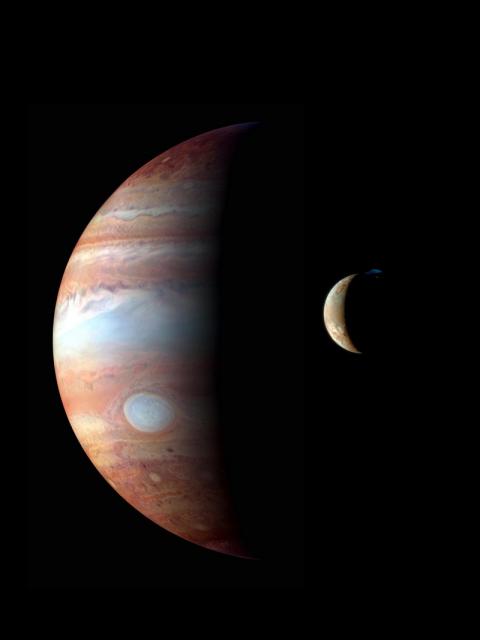
Of course, Jupiter's low frequency radio waves are much more powerful, since its magnetic field can exceed 20,000 times the strength of that generated by the Earth. Secondly, the chemical composition - thus the atmospheres - of the two planets are totally different from one another. The radio emissions on Jupiter are in fact generated by the volcanic activity of one of the moons, Io, which is further strengthened by the rotation of the planet. Ionized gas being ejected from Io is sent into a direction opposite to Jupiter, due to the massive centrifugal force exerted by planet, while electrons are drawn into the magnetic field, to be energized and accelerated by the low frequency radio waves.
A rather similar process is taking place in Earth's magnetosphere, in the areas commonly known to us as the Van Allen radiation belts. Understanding how the electrons are being accelerated within the magnetic field would prove valuable while trying to predict solar weather and possibly how satellites are affected by the deadly radiation shower. It is well known that the amount of radiation emitted from the Van Allen belts can change in a matter of minutes, severely affecting the forecasting capabilities.
Previously, scientists thought that electrons are accelerated through a transport process, but it was later shown that this is not enough to determine the appearance of such a phenomenon, since gyro-resonant waves seemed to have quite significant importance in the acceleration of electrons. Soon after the energizing of the electrons, they are redirected towards a position closer to the planet and release their energies through synchrotron emission of radiation.