 14 DAY TRIAL //
 Though proposed in theory for many years, the existence of dark galaxies has never been properly confirmed, until now. A team of astronomers surveying the deep Universe was recently able to pinpoint such cosmic formations, proving a number of astronomical models correct.
Using the European Space Observatory's (ESO) Very Large Telescope (VLT), in Chile, the research team investigated the existence of dark galaxies, formations that are believed to represent an early phase of galaxy formation.
In this stage of their assembly process, the formations contain vast reserves of gas, but no stars. Naturally, since they release no light, they are invisible at optical wavelengths, but the study used a cunning trick to get past this seemingly-insurmountable limitation.
With the help of VLT's amazing capabilities, the team was able to observe dark galaxies glowing under light shone on them by a quasar – the active core of a very distant galaxy, which is powered by a supermassive black hole.
According to theory, dark galaxies are the precursors of their modern, star-filled counterparts, and a necessary intermediary step in the formation of the latter. Many astronomers believe that these formations provided larger galaxies with the extra gas needed to form increasing numbers of stars.
While previous investigations caught glimpses of the existence of dark galaxies, in the brightness dip of very distant objects, the new research was the first ever to observe these structures directly.
“Our approach to the problem of detecting a dark galaxy was simply to shine a bright light on it. We searched for the fluorescent glow of the gas in dark galaxies when they are illuminated by the ultraviolet light from a nearby and very bright quasar,” researcher Simon Lilly says.
“The light from the quasar makes the dark galaxies light up in a process similar to how white clothes are illuminated by ultraviolet lamps in a night club,” he adds. The expert, a co-author on the new study, is based at ETH Zürich, in Switzerland.
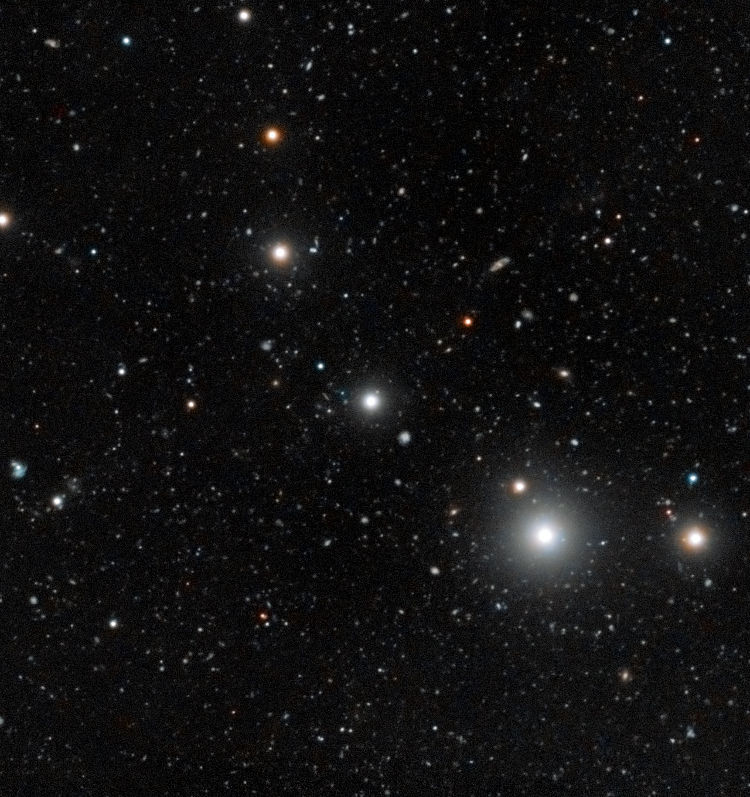
The study began when the VLT was made to target the bright quasar HE 0109-3518, and the areas around it. Eventually, the predicted faint glow of dark galaxies was discovered directly.
“After several years of attempts to detect fluorescent emission from dark galaxies, our results demonstrate the potential of our method to discover and study these fascinating and previously invisible objects,” adds Sebastiano Cantalupo.
The expert, who holds an appointment at the University of California in Santa Cruz (UCSC), was the lead author of the new study.