 14 DAY TRIAL //
 Such a question might seem inappropriate for the Sci/Tech section but, relax, I'm not going to talk about religion and the afterlife, I'm going to talk about quantum mechanics. Or more precisely, the consequences of certain popular interpretation of quantum mechanics.
Quantum mechanics is first of all a mathematical tool for predicting the results of all sorts of experiments. This tool happens to be incredibly accurate - its predictions fit the facts extremely well. However, when people start wondering about the actual significance of what they're doing, things get tricky. I had once given a talk about the various interpretations of quantum mechanics and at the time I managed to find seven totally different interpretations. A week later I came across another one! Probably there are at least a dozen totally different interpretations out there and each physicist has his own slightly different opinion about what is real and what is not in the mathematical fabric of quantum mechanics.
One of the most popular interpretations however, and which is now supported by the proponents of String Theory (one candidate for the so called grand-unified theory - of quantum mechanics and gravity), is that the mathematics of quantum mechanics actually reflects reality itself.
The problem with that: In order to compute anything in quantum mechanics, one identifies all the possibilities, assigns to each of them a certain tag (called 'amplitude of probability'), mixes up all the tags together and obtains a some sort of average tag (sums all the amplitudes), and then uses this average tag to say what is more or less probable to happen. The problem is that, if you take this mathematical scheme seriously, you are lead into believing the world around you is nothing but some sort of average world, and that, in Reality, all the possibilities actually co-exist beneath the surface of your observations. It's just that you are too dumb to see all the possibilities; you are just seeing some sort of average.
This may sound like rubbish (if it weren't for the experiments). One example: Everyone knows that light reflects from a mirror according to the reflection law (the incident angle is equal to the reflection angle). However, according to quantum mechanics, all the other possibilities (light reflecting in completely weird ways) do exist. It's just that, usually, they are eclipsed by the normal reflection law. Is it possible to make these possibilities visible?
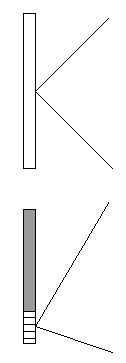
Well, the mathematics of quantum mechanics tells you how to make them visible. It tells you: Get rid of most of the mirror, make all sorts of very closely tied scratches on a remote part of the mirror, and light will reflect at unusual angles. Well, this actually works! You can verify it yourself with the help of a laser pointer and a CD. If you point the laser to the surface of a CD you will see that light reflects from the CD in more than one way - in more than the usual reflection law kind of way. So, does this prove that in fact all the possibilities co-exist? No. But it makes it reasonable for some people (e.g. the string theorists) to believe such a thing. What does all this have to do with death?
When you apply such ideas as superposition to life (or to the universe as a whole), you get the idea that you yourself don't exist in just one instance, it may seem so to you in the same way as it wrongfully seems that light reflects from a mirror only via the reflection law, but 'in Reality' there is an infinity of instances of yourself co-existing with 'you'. You, the one you perceive, is just a sort of average you.
Now, you may perceive death similar to the event of getting rid of a part of the mirror and scratching the remaining piece. When you die, today's average you disappears, in the same way as the normal reflection law may be made to vanish. But you don't disappear completely, you just change your ways. In this way it may be argued that in fact you will never really die completely and maybe even that you were never really born.
This view also changes things like ghosts from being nothing but paranormal absurdities to quantum mechanical predictions. If you take such a string theorist view you are bound to believe that ghosts exist!
It seems fascinating to me that modern fundamental physics is compatible with such ideas. Although I personally am totally against this kind of interpretation of quantum mechanics, as you can see from what I write on quantum teleportation, it is interesting that the experiments conducted so far don't actually deny the possibility of such beliefs.
Image credits: Touch of Death #3 cover, G.W. Fisher
Quantum Teleportation - The Fabricated Mystery
Superfluidity makes headlines once again
First Quantum Chip Takes Us One Step Closer to Quantum Computers