 14 DAY TRIAL //
 When bioengineers work in the lab to revert developed cells into their induced pluripotent (iPS) state, they often get a number of new cell colonies, of which only a small portion fits the exact type they are looking for. Just recently, Harvard Stem Cell Institute experts have managed to develop a new method of assessing the probability of a certain type of colony appearing following the procedures. The goal of the new technique is to evaluate the exact amount of fully reprogrammed iPS that are produced.
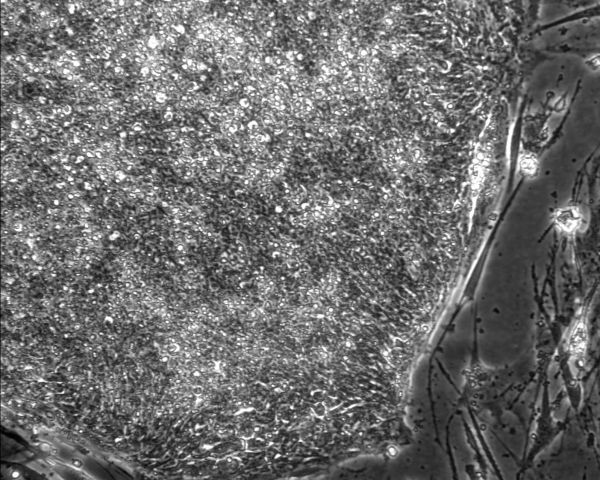
Essentially, the new observation method relies only on fluorescent-tagged antibodies and a camera, which can determine what type of culture has been obtained. If it gets to be widely implemented, it could undoubtedly lead to science groups obtaining the correct type of stem cells a lot more efficiently, and more often than until now. In their experiments, the researchers watched more than one million skin-tissue cells turning into iPS.
They then separated the real deal from the “copycat” colonies, and consequently sought to establish which of the colonies went on to produce high-quality stem cells. The research group was led by experts Thorsten Schlaeger and George Daley, Nature News reports. The new investigation “means that you can focus down on the most promising colonies and not assay everything,” University of California in San Francisco (UCSF) reprogramming expert Robert Blelloch says of the study. He adds that, in laboratories today, many teams place fully developed iPS cells together with only partially developed ones.
According to Schlaeger, the live-imaging method “allows us to identify earlier stages, so we can look at molecular events in these very rare cells.” Ontario Human Induced Pluripotent Stem Cell Facility Director James Ellis adds that, “It's extremely important to follow the fate of human iPS cells as they reprogram. This is really the first paper to do that on single human iPS cell colonies induced using the standard retrovirus vector reprogramming approach.”