 14 DAY TRIAL //
 Drawing inspiration from everyday life, a group of researchers from the US National Institute of Standards and Technology (NIST) and the University of Maryland devised a new way of producing custom-built liquid-filled vehicles called liposomes. These lipid bubbles hold great promise for protecting drugs during delivery throughout the human body. Generally, foreign chemicals come under attack from the immune systems, or are too unstable on their own to endure, and so protecting them inside liposomes could significantly increase their lifetime, and also their effectiveness.
In order to create the liposome manufacturing technique, the research team turned to washing dishes for inspiration. Each time soap bubbles form, they also include a few drops of water. When the bubbles burst, the water drops on the surfaces below. The NIST group developed a microfluidic device that exploits the same principles a few years ago, and now they expanded and improved on it with the help of colleagues from UM. One of the issues with their past device was the fact that the liposomes still had some problems that prevented them from being used at a large scale.
Limiting factors for these structures include structural instabilities (they popped open too quickly), high production costs, as well as inconsistencies when it came to producing them in a single size. The NIST/UM group now details its new manufacturing method, called COntrolled Microfluidic Mixing And Nanoparticle Determination (COMMAND), in a new scientific study, which was published in the March 31 issue of the esteemed scientific journal ACS Nano. This process can produce liposomes with a tunable diameter of between 50 and 150 nanometers, or billionths of a meter, the experts say.
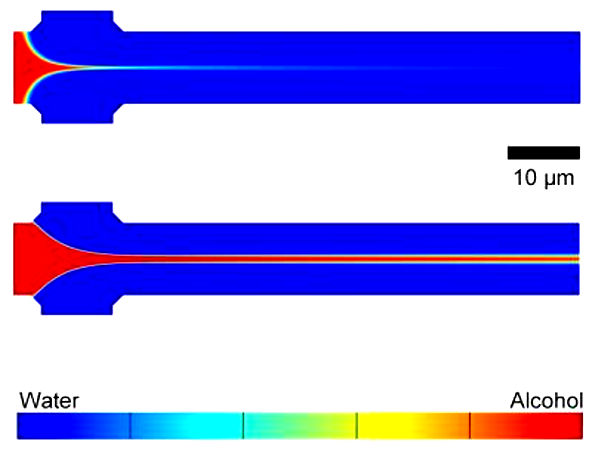
What the team developed can best be described as an “assembly-line-on-a-microchip,” a process in which the structures are produced uniformly and inexpensively. The COMMAND microfluidic devices themselves are easy to produce as well, by etching silicon wafers with tiny channels, in an approach similar to the one used for obtaining integrated circuits. In the new investigation, the flow and mixing of the fluid streams that go into the microfluidic device were found to be of the utmost importance in dictating the integrity of the resulting liposomes.