 14 DAY TRIAL //
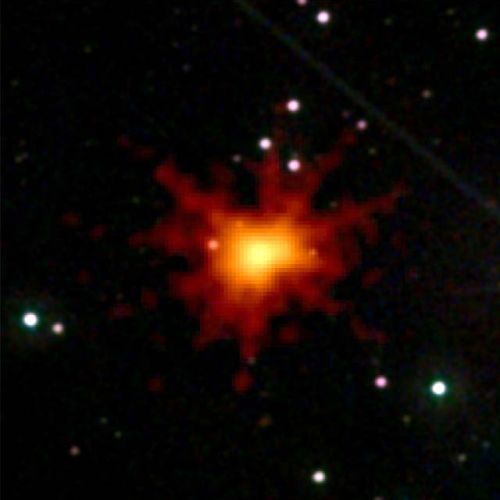
 On June 21, the brightest explosion ever seen in space temporarily blinded NASA's Swift observatory, scientists said on Wednesday. The gamma-ray burst called GRB 100621A, is the strongest and brightest that Swift has detected since 2005, 140 times brighter than any constant X-ray source in the sky, according to space experts.
Such explosions occur when a star dies. The burst sets off Gamma and X-rays radiations in every possible direction and it took 5 billion years for this explosion's radiation to get to the Swift space telescope. The light was so bright and intense that the observatory's software thought it was an anomaly.
“The burst was so bright when it first erupted that our data-analysis software shut down,” said Phil Evans of Britain's University of Leicester. “So many photons were bombarding the detector each second that it just couldn't count them quickly enough. It was like trying to use a rain gauge and a bucket to measure the flow rate of a tsunami.”
Neil Gehrels, Swift's principal investigator at NASA's Goddard Space Flight Center in Maryland, stated that theses X-rays' intensity was rather unexpected, and the first time that an explosion of such magnitude ever happen. “Just when we were beginning to think that we had seen everything that gamma-ray bursts could throw at us, this burst came along to challenge our assumptions about how powerful their X-ray emissions can be,” he added.
David Burrows, Penn State University astronomer and lead scientist for Swift's X-ray Telescope said: “This gamma-ray burst is by far the brightest light source ever seen in X-ray wavelengths at cosmological distances.”
This observatory was designed for capturing gamma-ray bursts from space, but nobody thought that they could be so intense, to temporarily blind a satellite. The star that exploded died in another galaxy, far beyond our Milky Way, according to British and NASA scientists.