 14 DAY TRIAL //
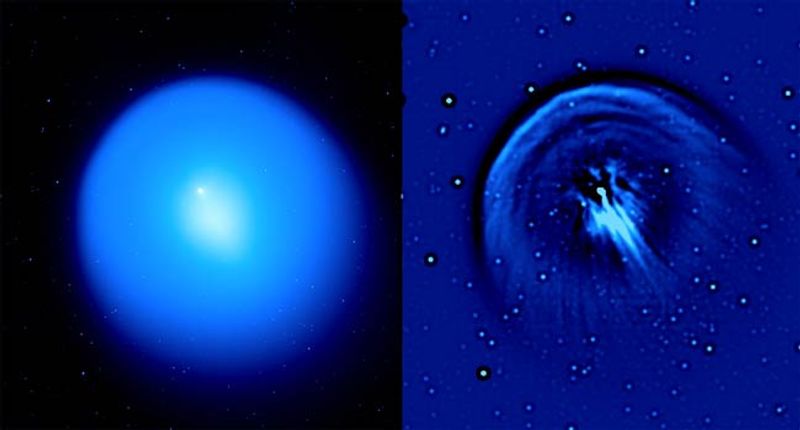
 In October 2007, as sky-watchers tracked the comet 17P/Holmes, they noticed that the celestial body increased considerably in brightness, by about a million times within a single day. This unusual occurrence prompted astronomers to start monitoring the body. Researchers at the University of California in Los Angeles (UCLA), led by expert Rachel Stevenson, noticed that numerous, smaller, bright fragments were thrown out from the core of the comet, and moved away from it at a great speed.
The 2.2-mile-wide (3.6-kilometer-wide) rock threw out fragments of its former self at speeds as high as 280 miles per hour (125 meters per second). As the science team watched in disbelief, the cloud of dust that was generated after this outburst grew to be larger than the Sun itself. Observations were conducted using the Canada-France-Hawaii Telescope, in Hawaii, the United States. Further analyses of photos taken with special, digital filters revealed that the new, smaller bodies, were not just rocks.
Rather, they were mini-comets, and each had a core that spewed out dust and gas, in very much the same way their larger counterparts did. “Initially, we thought this comet was unique simply because of the scale of the outburst. But we soon realized that the aftermath of the outburst showed unusual features, such as these fast-moving fragments, that have not been detected around other comets,” Stevenson says, quoted by Space.
She also adds that, at this point, there can only be speculations about what caused the comet to outburst in the first place. One possible theory, the expert explains, could be that pressure began to build up inside it a long time ago, and that it finally reached a critical mass in our time. It could be that the increased heat from the Sun was the cause of this build-up. When a part of its surface collapsed, the ensuing plumes of gas and dust may have carried with them smaller fragments as well.
After Holmes generated its mini-comets, it went about continuing its journey as if nothing happened. The astronomers noticed that it remained on the same orbit, unperturbed. More details about the peculiar celestial body will be presented today, at the European Planetary Science Congress, held in Potsdam, Germany. The comet takes six years to circle the Sun once, so astronomers will get a chance to photograph it again in 2014, as it will near the star once more.