 14 DAY TRIAL //
 A team of investigators reveals a new possible explanation for the geysers on the surface of the Saturnine moon Enceladus, which holds that the liquid ocean underneath exhibits a 'Perrier effect' of sorts.
Since the NASA Cassini orbiter has been orbiting the gas giant, astronomers have been surprised to discover that the moon Enceladus had tiger stripe-like features at its South Pole.
They were even more puzzled when closer flybys revealed that fact that the moon was spewing out jets of water-ice and organic particles, in what appeared to be geyser explosions.
The origin of this phenomenon has fascinated the international scientific community for several years, and a host of explanations have been put forth to explain what is happening.
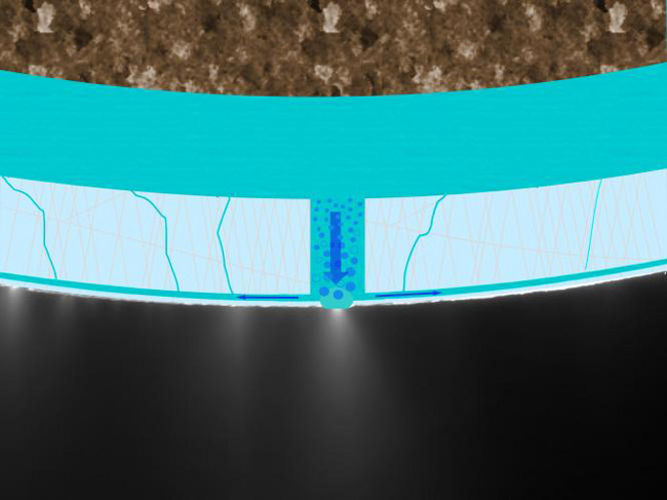
According to the new theory, it could be that the streams Enceladus spews out are “powered” by a bubbly ocean of liquid water flowing underneath.
“The realization that there's a circulation system inside of Enceladus is something that's a new way of thinking,” explained research scientist Dennis Matson, quoted by Space.
He holds an appointment at the NASA Jet Propulsion Laboratory (JPL), in Pasadena, California. The expert made the announcement in front of reporters on October 4, at the American Astronomical Society's Division of Planetary Sciences meeting.
“But as you know, Enceladus has unique properties,” he said. It could be that the sea that is located right under the crust is feeding the geysers with water, gas, dust and heat, before sinking back to the deaths as cooling plumes.
A computer model that the expert and his colleagues developed included all available data on Enceladus' geysers. The results supported the idea that a salty subsurface sea exists under the ices.
Due to the extremely cold average temperatures that are recorded on the Saturnine moon, it's very likely that the ice crust covering the submerged ocean is very thick, maybe a few miles.
This means that future missions to Enceladus will have a hard time penetrating the ices. At the low temperatures the moon has, that ice is harder than granite.
But, even if a direct mission to the moon is a long distance away, we still have Cassini to provide us with invaluable data of Saturn, its moons and its rings.
The orbiter has already discovered that the plumes Enceladus eliminates are mostly made up of water vapors, sodium salts, potassium salts and carbonates, and this supports the existence of a salty sea.