
NEWS CATEGORIES:


NEWS ARCHIVE >>
SOFTPEDIA REVIEWS >>
MEET THE EDITORS >>
Home / News / Science / Nature

Nature


'Camera Trap' Photographs Unknown Animal

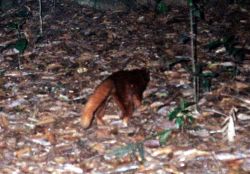
Slightly larger than a domestic cat, with dark red fur and a long, bushy tail

By Tudor Raiciu, Technology and Science Editor

6th of December 2005, 16:28 GMT

Adjust text size:


A World Wildlife Foundation "camera trap" in Borneo has photographed an animal that scientists have not been able to identify.

Slightly larger than a domestic cat, with dark red fur and a long, bushy tail, the animal was photographed twice at night in the dense forests of this tropical island that is home to one of the most diverse collections of species in the world.

A camera trap is an everyday camera armed with infrared sensors that take pictures whenever it senses
movement in the forest.

The creature could be an entirely new species or a new species of marten or civet cat, which looks like a cross between a cat and a fox. The researchers will set cage traps in the coming months in the hope of finding more about this creature. It is extremely rare to discover a new mammal species of this size.

"We showed the photos of the animal to locals who know the wildlife of the area, but nobody had ever seen this creature before," said Stephan Wulffraat, a biologist who is coordinating WWF's research on this species.

"We also consulted several Bornean wildlife experts and most were convinced it was a new species."

This strange animal might remain a mystery for ever if its habitat is not adequately protected, WWF representatives announced in the press release.

Kayan Mentarang National Park in Kalimantan, Indonesia, where the carnivore was photographed, is located in the "Heart of Borneo," a mountainous region covered with vast tracks of rainforest that is threatened by a proposed oil plantation that would be the world's largest.

"This discovery highlights the urgent need to conserve the unique forests in the Heart of Borneo. This creature hasn't been seen since the pictures were taken so it likely occurs in very low numbers," said Ginette Hemley, Vice president for Species Conservation.

Photo credit: WWF via U.S. Newswire
Read by 8,845 user(s) | Add comment | Link to this article TWEET THIS


Article rating:
Good (3.1/5) 9 vote(s)    

Subscribe to news | Print article | Send to friend

© Copyright 2001-2009 Softpedia
Contact:


SEARCH THE NEWS ARCHIVE :


Today's News
| Yesterday's News | News Archive


MORE RELATED ARTICLES:


First Photographs of Wild Gorillas Using Tools

Burmese Python Explodes While Digesting an Alligator

Scientists Discover Alleged 'Hobbit' Jaw Bone

Fossils of Humongous Sea Creature Discovered in South America

Puget Sound Orcas, Now An Endangered Subspecies

User opinions:


Comment #1 by: Nathan Ward on 17 Dec 2007, 23:59 GMT reply to this comment

I have seen photos from the late 1980's of an animal hiding in long grass taken on the side of the road on the outskirts of Kingaroy, which apears to have the head of a wallaby, but a body like a jackal, the photo was in an article on surviving relations of mainland Tasmanian Tigers, I no longer have access to this article and would like to know if anyone else knows what I am talking about or actually have knowledge of this image I am talking about. I am not surprised about this photo in this article, in my opinion, it is a relation to a quall reported in Noosa National Parks of a similar description.

Share your opinion:

Your Name:
Your Email Address:
(will not be used for commercial purposes)
Solve this to prove you're not a bot: =
Your review/opinion:


Windows tabGames tabDrivers tabMac tabLinux tabScripts tabMobile tabHandheld tabGadgets tabNews tab

SUBMIT PROGRAM   |   ADVERTISE   |   GET HELP   |   SEND US FEEDBACK   |   RSS FEEDS   |   ENTER NEWS SITE   |   ENGLISH BOARD   |   ROMANIAN FORUM