 14 DAY TRIAL //
 In modern physics, the photon is the elementary particle responsible for electromagnetic phenomena. It mediates electromagnetic interactions and makes up all forms of light. The photon has zero invariant mass and travels at the constant speed "c", the speed of light in empty space.
However, in the presence of matter, a photon can be absorbed, transferring energy and momentum proportional to its frequency. Like all quanta, the photon has both wave and particle properties, exhibiting wave-particle duality.
In general, it can only be observed when it disappears. The eye, like most light receivers, absorbs the photons it detects irreversibly, and the information carried by the light is destroyed as soon as it is recorded. We can of course see the same (macroscopic) object as often as we wish, but, each time, the photons which carry its image to our eye are new ones.
However, there is nothing in nature that says that photons have to be destroyed in order to be measured.
Microscopic quantum systems "jump" from one state to another in unexpected fashion. Physicists have already detected quantum jumps of atoms, electrons, ions and other particles. However, they had never yet seen this for photons.
For the first time, the researchers have observed "live" the history of the life and death of individual photons.
Photons are usually detected by atomic absorption. An atom can exist in different energy states, and it can absorb a photon by moving from one energy state to a higher one. By measuring the variation in energy of absorbing atoms crossing the cavity it would be possible to know whether an atom contains a photon, but this would destroy the photon and it would only therefore be seen once.
The researchers found a clever way of getting round this problem by choosing atoms of which transition between two states 0 and 1 corresponds to an energy which is different from that of the photons. In this case, the law of conservation of energy means that the atom cannot absorb the light.
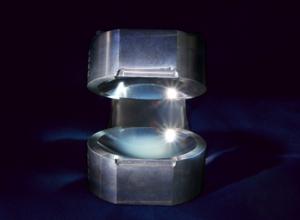
The key to the experiment is a "photon box", which is a cavity formed by two superconducting mirrors cooled to a temperature near absolute zero.
A photon from the residual thermal radiation bounces back and forth over a billion times between the mirrors, which are placed 2.7 centimeters apart, before it disappears (as opposed to a mere million times for mirrors reflecting photons of visible light). On average, the photon travels a distance equal to the Earth's circumference.
By observing such jumps over a period of several hours, the researchers directly confirmed the statistical properties of thermal radiation laid down a century ago by Planck and Einstein.
In this experiment, the information carried by a quantum of light is transferred hundreds of times to a physical system without being lost.
The same photon controls the state of a large number of atoms, which is a big step towards quantum information processing, as well as being a premiere in the scientific community.