 14 DAY TRIAL //
 The next science mission to Mercury, the innermost planet in our solar system, will feature a spacecraft that will attempt to do what has never been done before, survey the planet from a low elliptical orbit.
Plans are insert the satellite in an orbit that will take it between 400 and 1,500 kilometers (248 to 932 miles) above the planetary surface. Due to its proximity to the Sun, Mercury is tremendously hot.
Its surface is equally as hot, and so the new mission will literally have to fly through hell in order to conduct its observations. Recent tests have revealed that it's ready to take on this task.
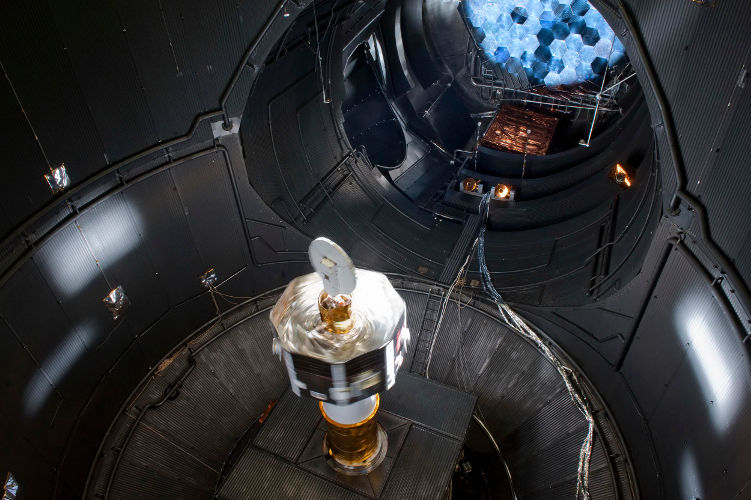
In experiments conducted earlier this month at the Large Space Simulator (LSS) facility – which is located in the Netherlands, at the European Space Research and Technology Center (ESTEC) – the probe was subjected to fiery temperatures for prolonged periods of time.
This was done in order to determine whether the special heat shields experts designed for it would hold to the unforgiving conditions around Mercury. The spacecraft passed with flying colors.
The BepiColombo Mercury mapper is the next probe being developed by the European Space Agency (ESA). The LSS is the only place in the world where the conditions around Mercury can be simulated with such degree of accuracy at such a large scale.
What the new tests were meant to show was that the Mercury Magnetospheric Orbiter (MMO), the spacecraft of the BepiColombo mission, was capable of reaching the innermost planet, and achieve orbital insertion around it.
The octagonal spacecraft that was put to the test is provided by the Japan Aerospace Exploration Agency (JAXA). It is protected by a heatshield developed at ESA especially for this mission.
Both components were made to endure temperatures exceeding 350 degrees Celsius (662 degrees Fahrenheit). But experts in charge of the LSS tests say this is only a prelude of things to come.
“The sunshield test was successful. Its function to protect the MMO spacecraft during the cruise phase was demonstrated,” ESA BepiColombo project manager Jan van Casteren explains.
“The tests allowed us to measure the thermal blanket's performance. The results allow us to prepare some adjustments for the tests of the Mercury Planetary Orbiter next year,” the official adds.
Further tests meant to assess the spacecraft's performances under intense heat and radiation will begin this summer, once more components are integrated into the JAXA-developed bus, SpaceRef reports.